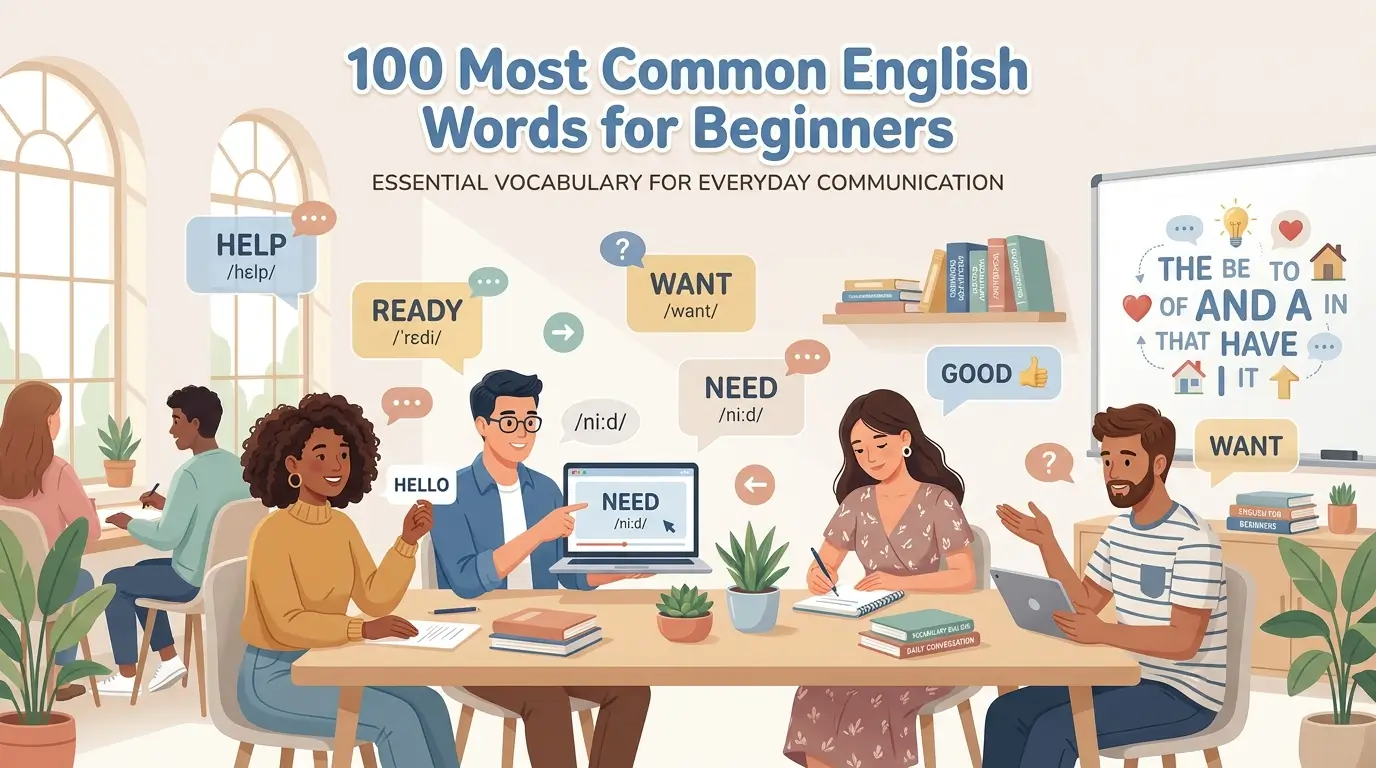
Learning English vocabulary was never really about memorizing long lists and hoping they stick. The actual goal is understanding how a word behaves in an ordinary situation, and feeling comfortable enough to just use it without stopping to translate first.
For anyone starting out, common words tend to matter more than obscure ones. Something like help, need, want, happy, sorry, or ready shows up constantly — in conversations, text messages, classrooms, workplaces, more or less everywhere English gets used casually.
Memorizing a translation alone rarely covers it, though. A single word can carry several meanings, shift form depending on the sentence around it, or sound almost nothing like its spelling suggests.
This guide walks through some genuinely useful daily-use words, shows how they tend to get used in practice, and flags a few mistakes worth watching for.
What Are Daily-Use English Words?
Daily-use words are, more or less, whatever people reach for constantly when talking, texting, asking questions, describing how they feel, or just narrating an ordinary day.
Happy — feeling good or pleased. Sad — feeling unhappy. Help — to give assistance. Need — to require something. Want — to wish for something. Work — an activity or job.
None of these look impressive on paper. They're still genuinely useful — someone who knows this kind of vocabulary can start building real sentences almost immediately, well before tackling anything more advanced.
Why Start With Common Words?
You don't need thousands of words banked before speaking a sentence of English. A smaller, frequently used set gives you somewhere real to start.
Once the basics are in place, they combine easily: "I need help." "I want some water." "She is happy." "I have work today." The more these particular words get used, the faster they stop feeling like vocabulary and start feeling like just... talking.
Useful English Words for Daily Conversations
Here's a starting set worth practicing early on.
| Word | Meaning | Example Sentence |
|---|---|---|
| Happy | Feeling pleased or joyful | I am happy today. |
| Sad | Feeling unhappy | He looks sad today. |
| Angry | Feeling upset or mad | She is angry about the problem. |
| Busy | Having many things to do | I am busy right now. |
| Help | To assist someone | Can you help me? |
| Need | To require something | I need some water. |
| Want | To wish for something | I want a cup of tea. |
| Easy | Not difficult | This question is easy. |
| Hard | Difficult | English pronunciation can be hard at first. |
| Clean | Not dirty | Please keep your room clean. |
| Ready | Prepared for something | Are you ready to go? |
| Good | Pleasant, useful, or positive | That is a good idea. |
| Bad | Not good | I had a bad day. |
| New | Recently made or obtained | I bought a new phone. |
| Old | Having existed for a long time | This is an old building. |
English Words You Use When Speaking
A few words earn their place specifically because they help you respond to other people — politely, quickly, and without sounding stiff.
Okay
Meaning: shows agreement, acceptance, or understanding. Example: "Okay, I understand." It also works when someone's checking whether something suits you: "Is this time okay for you?"
Sorry
Meaning: used when apologizing or expressing regret. Example: "Sorry for being late." A single "sorry" covers a surprising range of situations — a real apology, sure, but also just politely getting someone's attention in a crowded room.
Please
Meaning: softens a request. Example: "Please open the window." Compare "Give me the book" with "Please, give me the book" — the second version reads as considerably more polite, for one extra word.
Thanks / Thank You
Meaning: expresses gratitude. "Thanks for your help." "Thank you for explaining that." Thanks tends to stay casual; thank you slides comfortably into both casual and more formal situations.
Sure
Meaning: often shows agreement or willingness. "Can you help me?" "Sure!" It also confirms something's fine: "Can I call you later?" "Sure."
Common Mistakes When Learning English Vocabulary
Knowing a definition is really just the starting point. A lot of learners get stuck because they learn words in isolation, disconnected from how those words actually behave inside a real sentence.
1. Memorizing a Word Without Learning Its Context
A dictionary entry rarely tells you how a word actually sounds in conversation. "Run = move quickly on foot" is fine as far as it goes, but run also shows up as: "I run every morning." "She runs a small business." "The machine is running." The meaning shifts with context every time. Whenever a new word comes up, it's worth learning at least one or two natural sentences alongside it, not just the definition on its own.
2. Translating Every Word Directly
Word-for-word translation tends to produce sentences that sound off to a native ear, even when every individual word is technically correct.
Something translated too literally from another language might come out as "I am taking tension," where natural English would just say "I am stressed." Learning whole expressions as phrases, rather than translating word by word whenever possible, tends to avoid this particular trap.
3. Mixing Up Similar Words
English is full of near-twins that look or sound alike but mean different things.
Affect usually works as a verb: "Lack of sleep can affect your concentration." Effect usually works as a noun: "Lack of sleep can have an effect on your concentration."
Lose means to no longer have something: "Don't lose your keys." Loose means not tight: "This shirt is too loose."
Catching this distinction early tends to save a fair number of repeated mistakes down the line.
4. Ignoring Pronunciation
English spelling and pronunciation don't always agree with each other, which is putting it mildly. Knife has a silent k. Debt has a silent b. Honest has a silent h. Listen has a silent t.
Vocabulary practice that skips pronunciation misses half the actual skill. It's worth asking not just "what does this word mean?" but also "how do I actually say it?"
5. Learning Words but Never Using Them
A word sticks considerably better once you've actually used it a few times, rather than just read the definition once and moved on.
Take ready. Instead of reading its meaning and closing the book, try a few sentences: "I am ready." "Are you ready?" "We are ready to leave." Repeated use in slightly different situations is really what turns a word from something you recognize into something you can reach for while actually speaking.
How to Learn Common English Words More Effectively
None of this requires hours of memorization each day. A modest, consistent routine tends to outperform an intense one that fizzles out after a week.
Learn a Small Number of Words
Five to ten words a day is plenty. For each one, it's worth covering the word itself, its pronunciation, a simple meaning, an example sentence, and one common phrase built around it.
Fig. 1 — Five things worth learning for every new word
Need, for instance — meaning: to require something. Example: "I need some help." Useful phrase: "I need to..." From there, building your own sentences gets easy: "I need to study." "I need to call my friend." "I need to finish my work."
Say New Words Out Loud
Reading a word silently is useful, but saying it out loud is a genuinely different kind of practice. Say the word a few times, then drop it into a full sentence — it tends to build comfort with both pronunciation and actual speaking, not just recognition.
Keep a Vocabulary Notebook
A simple table works fine — word, pronunciation, meaning, and a sentence you wrote yourself.
| Word | Pronunciation | Meaning | My Sentence |
|---|---|---|---|
| Ready | ... | prepared | I am ready for work. |
| Need | ... | require | I need some water. |
| Busy | ... | having lots to do | I am busy today. |
Writing your own sentence rather than copying an example forces you to actually think through how the word behaves, which tends to matter more than the notebook itself.
Review Instead of Constantly Adding New Words
Fifty new words half-forgotten by the weekend does less for you than ten words you can genuinely use. Reviewing yesterday's list before adding today's tends to matter more than the total count ever does.
A rough pattern that holds up: day one, learn ten words. Day two, review those ten and add five to ten more. Day three, review again. End of the week, test yourself on the lot.
Final Thoughts
Building English vocabulary doesn't need to feel like an uphill climb. Start with words you're actually likely to run into on an ordinary day, learn them inside real sentences rather than in isolation, and use them yourself as soon as you can.
Pay attention to pronunciation, especially wherever spelling and sound genuinely disagree. And don't worry too much about mistakes along the way — using a word incorrectly once probably teaches you more than rereading its definition five times ever will.
The most useful vocabulary, in the end, is whatever you can recognize, understand, pronounce, and actually use without hesitating. Pick a handful of common words today, build a few sentences around them, and try them out in an actual conversation. Small, regular practice like that tends to add up, slowly turning simple vocabulary into something closer to real fluency.