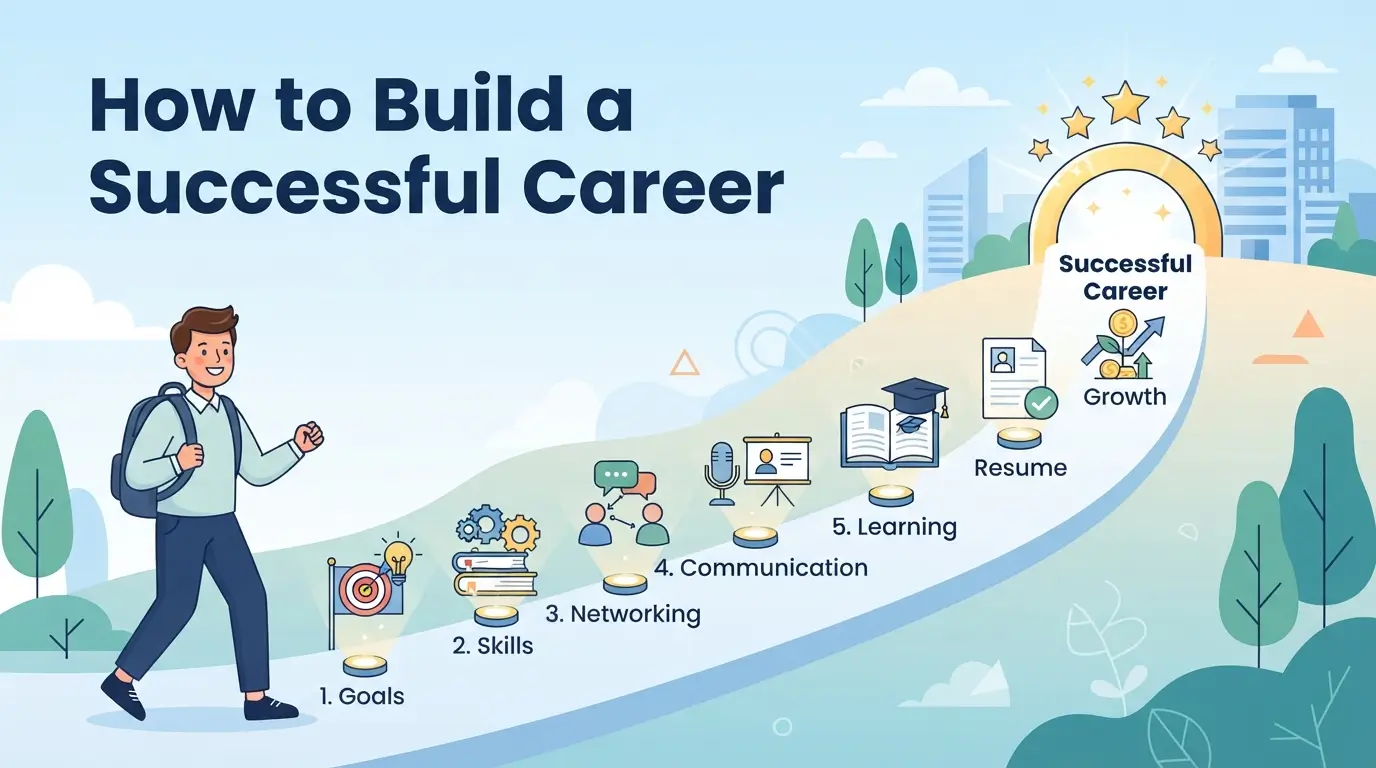
Building a successful career was never really just about the salary number or the job title on your business card. For some people, success mostly means financial security — a paycheck that doesn't keep you up at night. For others it's doing work that feels worth doing, picking up skills that actually matter, having some say over your own schedule, or just landing somewhere that fits who you are.
Whatever version of success you're aiming for, getting there usually takes time, some planning, a fair amount of ongoing learning, and a willingness to change course when the original plan stops making sense. You don't need your whole professional future mapped out on day one. What tends to matter more is knowing roughly where you want to go, taking a few concrete steps toward it, and checking in on your own progress every so often rather than assuming it'll sort itself out.
Here are ten practical, fairly unglamorous tips for building a career that holds up over the long run.
1. Identify Your Skills, Interests, and Strengths
Before settling on a direction, it's worth spending some real time figuring out what you're actually working with.
Think about which subjects and activities you enjoy, which skills already come naturally, and what kind of work leaves you with something like satisfaction at the end of the day rather than just relief that it's over. Consider both the technical stuff and the softer strengths.
You might, for instance, be good at talking to people, solving problems, organizing chaos into something manageable, working with numbers, writing, leading a small team, doing something creative, or picking up new software faster than everyone else in the room.
Interests matter here too, probably more than people give them credit for. A career that lines up with your abilities but ignores everything you're actually interested in can get difficult to sustain once the novelty wears off. Genuinely knowing your own personality, values, and abilities tends to narrow down the career paths worth taking seriously in the first place.
2. Set Clear Career Goals
A goal gives you something concrete to aim at. Without one, it's easy to drift from job to job, or opportunity to opportunity, without ever quite knowing whether you're actually getting anywhere.
Try setting both a short-term goal and a longer one. A short-term goal might be finishing an online course in digital marketing within three months. A longer-term one might be becoming a digital marketing specialist within three years.
The SMART framework is a fairly reliable way to structure these: specific (define exactly what you're going for), measurable (decide how you'll know you've gotten there), achievable (realistic given where you're actually starting from), relevant (tied to your broader plans, not just a random ambition), and time-bound (a real deadline attached to it).
Fig. 1 — The SMART goal framework
Writing goals down, rather than just holding them loosely in your head, makes them considerably easier to revisit and adjust as things change.
3. Create a Career Plan
Once the goals exist, the next question is how you actually get there.
A career plan turns a broad ambition into smaller steps you can act on this month. Start from where you want to end up and work backward from there.
Worth asking yourself: what position do you actually want down the line? What qualifications does it require? Which skills still need developing? What experience would make you a stronger candidate than you are right now? Who might know more about this field than you do? And what, realistically, could you get done in the next six months?
The plan doesn't need to be permanent, and it probably shouldn't be treated as if it were. Industries shift, interests shift, and opportunities show up that nobody could have planned for in advance. Reviewing the plan now and then, and changing it when the situation calls for it, tends to serve people better than clinging to a plan built on assumptions that stopped being true two years ago.
4. Build a Strong Professional Network
Your network can end up being one of the more useful resources you have, and not in the transactional way people sometimes imagine.
Networking isn't really about collecting contacts the way you'd collect stamps. It's closer to building actual professional relationships with people who can share knowledge, advice, the occasional opportunity, or just a different way of looking at a problem you're stuck on.
A few ways this tends to happen in practice: connecting with people on LinkedIn, showing up to career fairs and industry events, joining a professional group, attending a workshop or training session, sitting in on an online conference, finding a mentor, or simply staying in touch with former classmates and colleagues instead of letting those relationships quietly lapse.
5. Improve Your Communication Skills
Technical knowledge gets you through the door. Communication is usually what determines how well you actually work with the people already inside it.
Good communication is more than speaking clearly, though that's part of it. It also involves listening properly, asking questions that actually move a conversation forward, writing in a way people can act on quickly, picking up on non-verbal cues, and adjusting your tone depending on who's in the room.
Worth building, in no particular order: active listening, clear writing, speaking with some confidence, asking good questions, empathy, knowing when humor helps and when it doesn't, reading body language, managing your own tone and volume, explaining ideas without over-complicating them, and handling a difficult conversation without making it worse.
If English happens to be the working language wherever you are, sharpening your English vocabulary, writing, speaking, and listening can make a genuinely noticeable difference to how smoothly all of the above actually goes — our English Learning and Workplace English sections both dig into this in more detail.
6. Continue Learning and Develop New Skills
A career doesn't stop asking things of you the day you land the job.
Technology shifts, industries shift, and what an employer expects from a given role tends to shift right along with them. A skill that matters a great deal today might matter less in five years, while something that barely existed as a job requirement a decade ago might now be the whole reason you got hired.
Worth considering: an online course, a professional certification, a workshop, vocational training, an industry-specific course, or some kind of hands-on training program.
That said, collecting certificates purely to pad out a resume rarely helps much. It's worth picking learning that's actually connected to where you're trying to go, rather than whatever happens to be trending that month. Ongoing learning also tends to make switching careers less frightening, since you can build relevant skills gradually, in the background, before making any kind of dramatic jump.
7. Create a Professional Resume and Cover Letter
Your resume is often the very first thing an employer sees of you, so it's worth making sure it actually says what you want it to say.
A resume that works tends to be relevant to the specific job, easy to read at a glance, reasonably concise, free of the kind of spelling slip that undermines everything else on the page, focused on skills and real achievements rather than vague duties, and formatted in a way that doesn't fight the reader.
Sending the identical resume to every employer is a habit worth breaking. Read the job description properly, and lean into whatever experience actually lines up with it. Applying for a marketing role, for instance, probably means foregrounding marketing projects, communication experience, and digital or analytical skills — not giving equal space to a summer job that has nothing to do with any of it.
A cover letter earns its place by adding something the resume can't, rather than repeating it. Use it to explain why the role interests you specifically, and how what you've actually done might translate into value for that particular organization. Our complete CV writing guide covers this step by step.
8. Develop a Professional Personal Brand
Your personal brand, stripped of the marketing language around it, is really just the professional impression people end up carrying around about you.
None of this requires becoming an online personality or spending your evenings promoting yourself. It can be as simple as consistently showing up as reliable, competent, and reasonably easy to communicate with — over and over, until that's just what people associate with your name.
A few ways this tends to build: keeping a LinkedIn profile that's actually current, sharing something genuinely useful about your field now and then, putting together a portfolio, publishing an article or a project you're proud of, keeping your resume up to date even when you're not job hunting, letting your actual work demonstrate your expertise rather than just claiming it, and keeping some consistency in how you present yourself professionally.
Worth asking yourself directly: what do you want people to remember about you specifically? Maybe it's being the person who writes clearly, or the one who actually finishes projects on time, or the one who comes up with the unexpected solution. Whatever it is, your day-to-day work is what slowly builds that reputation — not a single LinkedIn post.
9. Track Your Job Search and Career Progress
Career development gets a lot easier to manage once you can actually see what you've done and where the gaps still are.
If you're actively job hunting, a simple spreadsheet tracker tends to help more than people expect. Useful columns might include the company, the position, the date you applied, the current status, any interview date, and whatever follow-up is still pending.
| Company | Position | Application Date | Status | Interview | Follow-Up |
|---|---|---|---|---|---|
| Company A | Marketing Assistant | Sept. 5 | Applied | — | Sept. 12 |
| Company B | Content Writer | Sept. 7 | Interview | Sept. 15 | — |
A tracker like this keeps applications from turning into a blur of half-remembered emails. It can also surface patterns you'd otherwise miss. Thirty applications with almost no interviews probably says something about the resume or the targeting, not just bad luck. Plenty of interviews that never turn into offers might mean the interview itself — not the paperwork — is where it's worth focusing next.
10. Take Responsibility and Maintain a Growth Mindset
Careers rarely move in a straight line. Rejection happens. Mistakes happen. So do difficult colleagues, interviews that go nowhere, and stretches where nothing seems to be moving at all.
Rather than treating every setback as evidence that you simply can't do this, it's worth asking what, specifically, there is to learn from it.
A growth mindset, in practice, just means treating skills and challenges as things that develop through practice and effort rather than fixed traits you either have or don't. Instead of thinking "I'm not good at interviews," something like "what could I actually improve before the next one?" tends to open up more useful next steps.
Taking responsibility matters here too. You can't control most of what happens to you in a career — who gets promoted, which companies are hiring, how a given interviewer happens to feel that day — but you can control your own preparation, your responses, and the effort you put in. When something goes badly, it's usually more useful to look for the lesson than to spend the energy on blame, whether that blame is aimed outward or at yourself.
When Your Career Does Not Go According to Plan
Even a carefully built career takes turns nobody planned for.
You might end up disliking the field you trained for. You might lose a job you thought was secure, get passed over for a promotion you expected, or simply notice one day that the role you're in no longer matches what you actually want. None of that automatically means anything has failed.
It's worth treating moments like these as a chance to reassess rather than a verdict. Useful questions here: what did this experience actually teach you? Which parts of the work did you genuinely enjoy? What skills came out of it, even the ones you didn't set out to build? What would you do differently next time? Is there a different path that suits your actual strengths better than this one did? And what do you need to learn or pick up for whatever comes next?
Career development tends to look more like a series of adjustments than a straight line drawn in advance — which is probably closer to how most careers actually work, however tidy they look from the outside.
Seek Guidance When You Need It
None of this has to be worked out entirely alone.
A mentor, a career advisor, a former teacher, an experienced colleague, or any other professional you trust can offer a perspective you might not have landed on by yourself. This tends to matter most when you're choosing between genuinely different paths, gearing up for a job search, changing industries entirely, or just trying to work out what employers in a given field actually expect from candidates.
Landing Your Dream Job
Building a successful career takes more than landing a job. It means understanding yourself reasonably well, setting goals that actually mean something to you, building skills deliberately, forming real professional relationships, communicating well, and staying open to learning even once things feel settled.
Start small. Figure out what you actually want, build a plan you're willing to revise, work on one skill at a time rather than all of them at once, and check in on your own progress every so often instead of only during a crisis.
Your own definition of success will probably shift as you go — that's normal, not a sign you got it wrong the first time. What seems to matter more than any fixed definition is continuing to move toward some combination of growth, opportunity, stability, and whatever actually satisfies you, since that combination looks a little different for everyone.
A career like that doesn't get built in one decisive year. It gets built through fairly ordinary decisions, repeated consistently, over a long stretch of time.