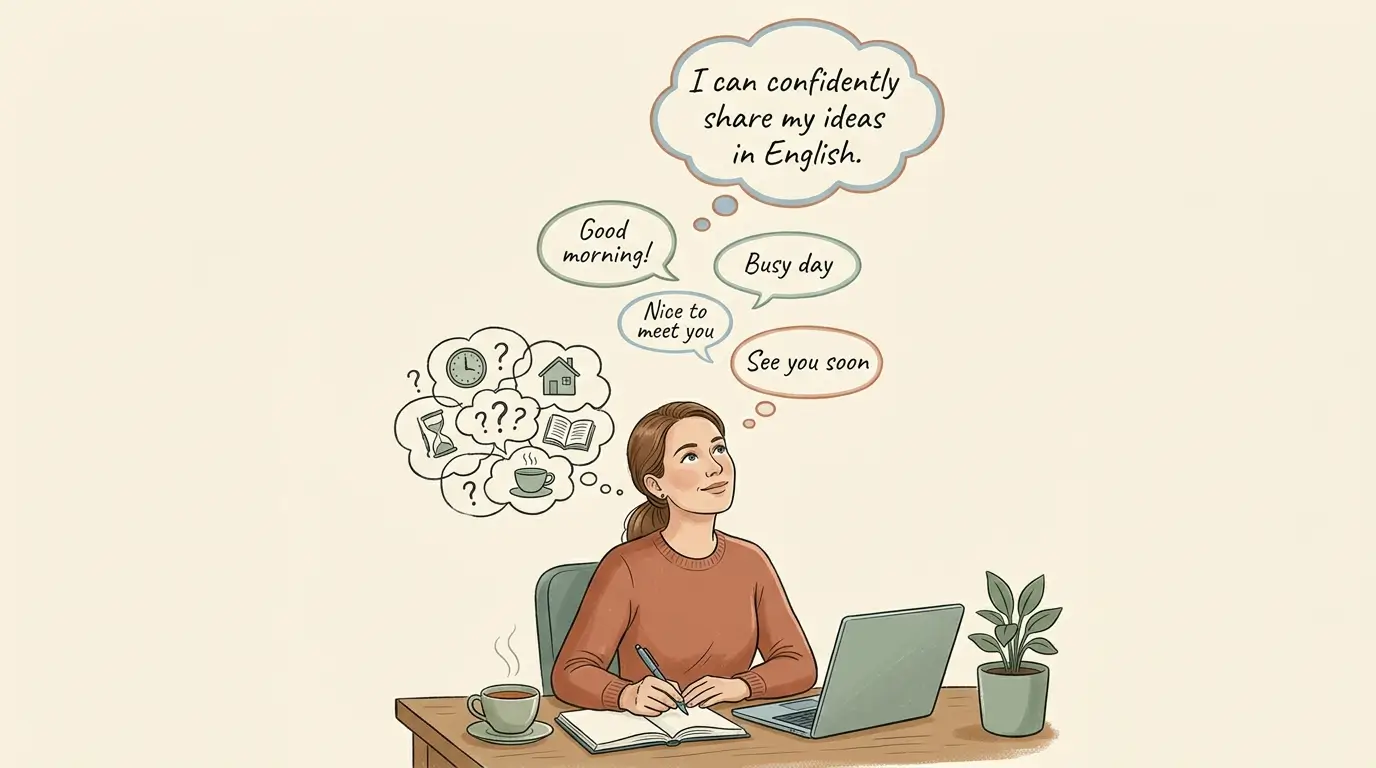
You understand the question perfectly. Someone asks what you think about the new schedule, and you know exactly what you'd say. Then comes the detour: the sentence forms in your first language, you hunt for English equivalents, you check the grammar, and by the time you're ready to speak, the conversation has moved on.
This happens to learners who've studied for years, not just beginners. Understanding English and producing it on the spot are different skills, and the second one needs its own practice. You might recognize hundreds of words on a page and still struggle to retrieve them quickly in a live exchange.
The aim isn't to banish your first language. Translation is genuinely useful for tricky vocabulary or a difficult idea. It's when every sentence has to pass through it that speaking starts to feel slower and more stressful than it should.
The habit of thinking directly in English can be built gradually. Here are eight practical ways to start.
1. Start With the English Words Around You
There's no need to sit at a desk for this. Begin with what's in front of you.
When you wake up, name what you see: window, pillow, cup of tea, phone charger, open door. Once those feel familiar, stretch them into short phrases — a comfortable pillow, a hot cup of tea, an open window — and later into simple sentences like "I need to charge my phone" or "The tea is getting cold."
The point is to link each English word directly to the thing it describes, rather than routing through a translation first.
Try this: spend two minutes naming objects around your room in English. If a word won't come, skip it and keep going. You can look up the gaps afterward.
2. Describe Your Daily Activities in English
Routines make good practice material because you already know what you're doing. All your effort goes into the English, not into inventing an idea.
While making breakfast, you might think: "I'm making coffee. I need to wash this cup. Where did I put the spoon?" On the way to work: "I'm waiting for the bus. There are quite a few people at the stop. I hope the traffic isn't too bad today."
None of this needs to be impressive. As it gets easier, add plans, reactions, and opinions: "I have a busy afternoon, so I should finish this task before lunch." Over time, that kind of habit tends to make it easier to describe similar situations to another person.
3. Listen to English and Repeat Useful Phrases
Listening teaches you how English sounds in real conversation, and repeating what you hear gives you a chance to produce those sounds yourself.
Choose a short video, podcast segment, or conversation at a comfortable level. Listen for natural expressions: "That sounds good." "Let me think about it." "I'm not sure about that." "Could you explain that again?" "It depends on the situation."
Play one phrase, pause, and say it aloud, copying the rhythm as best you can. Exact native-speaker pronunciation isn't the target.
Phrases tend to serve conversation better than isolated words. Learning "make a decision" gives you something ready to use, where a loose word means building the phrase from scratch each time. Repeat a handful over several days and put them into your own sentences.
4. Practice Speaking Without Translating Every Word
Many learners stall because they try to express a complicated thought before they have the English for it. A better move is to say the basic idea with the words you already have.
Can't remember "exhausted"? "I'm very tired because I worked all day" gets the message across. Forgot "thermometer"? "The thing we use to check someone's temperature" does the job.
This skill is sometimes called circumlocution — explaining an idea in other words when the exact one isn't available. It's useful in everyday conversation, job interviews, and workplace discussions, because communication doesn't have to stop whenever a word goes missing.
5. Prepare for Common Questions
Certain questions come up again and again. Building a fresh answer each time makes even a simple exchange feel heavy.
"How are you?" — "I'm doing well, thanks." "Pretty good. How about you?" "I'm a little tired today."
"How was your weekend?" — "It was relaxing. I stayed home and watched a film." "It was busy because I had some work to finish." "It was good. I visited some friends."
The same approach works for questions about your job, studies, hobbies, and plans. Avoid memorizing whole conversations as rigid scripts. A few flexible expressions, with the details swapped in, leave room for genuine conversation.
6. Watch Videos Without Leaning on Subtitles
Films, interviews, and online videos let you hear English as people actually use it. Subtitles in your own language, though, can pull your attention away from the spoken words.
A three-step approach tends to work well. First, watch a short clip with English subtitles if you need help following it. Second, watch it again with the subtitles off, if the dialogue feels manageable. Third, repeat one or two useful lines and explain what happened in your own words.
Understanding every sentence isn't necessary. Aim for the main meaning and notice expressions that keep recurring. Content you actually enjoy — workplace interviews, cooking videos, travel stories, sports talk — makes a regular listening habit much easier to keep.
7. Create Small English-Only Practice Sessions
Living in an English-speaking country isn't a requirement. You can carve out 10 to 15 minutes in which you think, read, listen, or speak only in English, without translating each sentence.
Describe a photograph. Plan tomorrow's schedule. Explain a news story. Talk through a problem you solved at work.
If you can, practice with a friend, colleague, teacher, or language partner. Real conversation throws up unexpected questions and forces you to ask for clarification, which solo practice can't fully reproduce. Start somewhere comfortable. There's no need to jump into a hard conversation before you feel ready.
8. Write Briefly to Organize Your Thoughts
Writing and speaking are different skills, but a short daily writing exercise helps you form ideas directly in English.
At the end of the day, write three to five sentences: "Today was busy at work. I finished a report before lunch. One meeting lasted longer than expected. Tomorrow, I want to start my main task earlier."
Keep it simple at first. If a word won't come, explain the idea another way or mark the gap for later. Shopping lists, short messages, daily plans, and notes on something you watched all count. What matters is making English part of your routine, not something reserved for study time.
A Simple 15-Minute Daily Routine
Consistency is easier when practice fits into the day you already have. Treat this as a starting point and adjust it to your level.
Fig. 1 — A simple 15-minute daily routine
| Time | Activity | Goal |
|---|---|---|
| 3 minutes | Name objects around you in English | Connect words with real things |
| 4 minutes | Listen to a short clip and repeat phrases | Improve listening and pronunciation |
| 4 minutes | Describe your day aloud | Build speaking habits |
| 4 minutes | Answer three common questions | Respond more quickly |
After a week, check which activities felt easiest and which pushed you. Keep the ones that help most, then gradually add longer sentences or harder topics. Familiar expressions may start surfacing faster, though the pace varies from person to person, so it's wiser to watch your own progress than to expect fluency by a fixed date.
Common Mistakes to Avoid
Translating Every Sentence Perfectly
This slows you down and turns ordinary conversation into a grammar test. Aim to communicate clearly first and refine the details later.
Looking Up Every Unfamiliar Word Immediately
Dictionaries are valuable, but stopping every speaking exercise to search means you never practice working around a gap. Finish the thought when you can.
Choosing Material That Is Too Difficult
If you understand very little of a video, most of your time goes on feeling lost. Pick material where you can follow the general meaning, then raise the difficulty gradually.
Practicing Only in Your Head
Silent thinking helps, but speaking aloud trains pronunciation and sentence production in a way silence doesn't. Include both.
Expecting Instant Results
You may still translate when a topic is unfamiliar or the pressure is on. That doesn't mean it isn't working. Keep practicing and see whether familiar situations get easier over time.
Frequently Asked Questions
How can I stop translating in my head when speaking English?
Start with familiar subjects and simple sentences. Practice naming objects, describing daily activities, repeating common phrases, and answering familiar questions aloud. Gradually, some expressions may come to mind without deliberate translation.
How can I learn to think in English every day?
Build short English activities into your routine: describe what you see, talk through your plans, listen to English content, or write a few sentences about your day. Practice sticks better when it's tied to things you already do.
Should I stop using my native language to learn English?
No. Your first language can help with difficult concepts and unfamiliar words. The aim is to cut unnecessary translation during speaking practice, not to avoid your first language altogether.
Does thinking in English improve speaking fluency?
It can help you respond more directly and lean less on translating each sentence. Fluency also depends on listening comprehension, vocabulary, pronunciation, and real conversation practice, so developing those together tends to work better than focusing on thinking alone.
How long does it take to start thinking in English?
There's no fixed timeline. Some familiar words and phrases may become easier to recall after regular practice, while spontaneous conversation can take considerably longer. Your starting level, practice habits, and exposure to English all play a part.
What should I do when I forget an English word during a conversation?
Explain the meaning with simpler words, describe what the object or action does, or give an example. You can also ask, "What's the word for something that…?" That keeps the conversation moving and gives you a chance to learn the missing expression.
From Translation to Direct Thought
Thinking in English was never really about forcing yourself to stop using your first language. It's about building a direct link between English and your everyday experience.
Start with simple observations. Describe familiar activities. Repeat useful phrases and practice common questions. When a word escapes you, explain the idea rather than stopping. As your comfort grows, use English with other people whenever the chance comes up.
Hours of free time and a perfect learning environment aren't required. A few focused minutes a day provide regular openings to practice.
The next time you make a cup of tea, ride to work, or plan your afternoon, try describing what you're doing in English. That small habit could be a useful step toward more natural, confident communication.