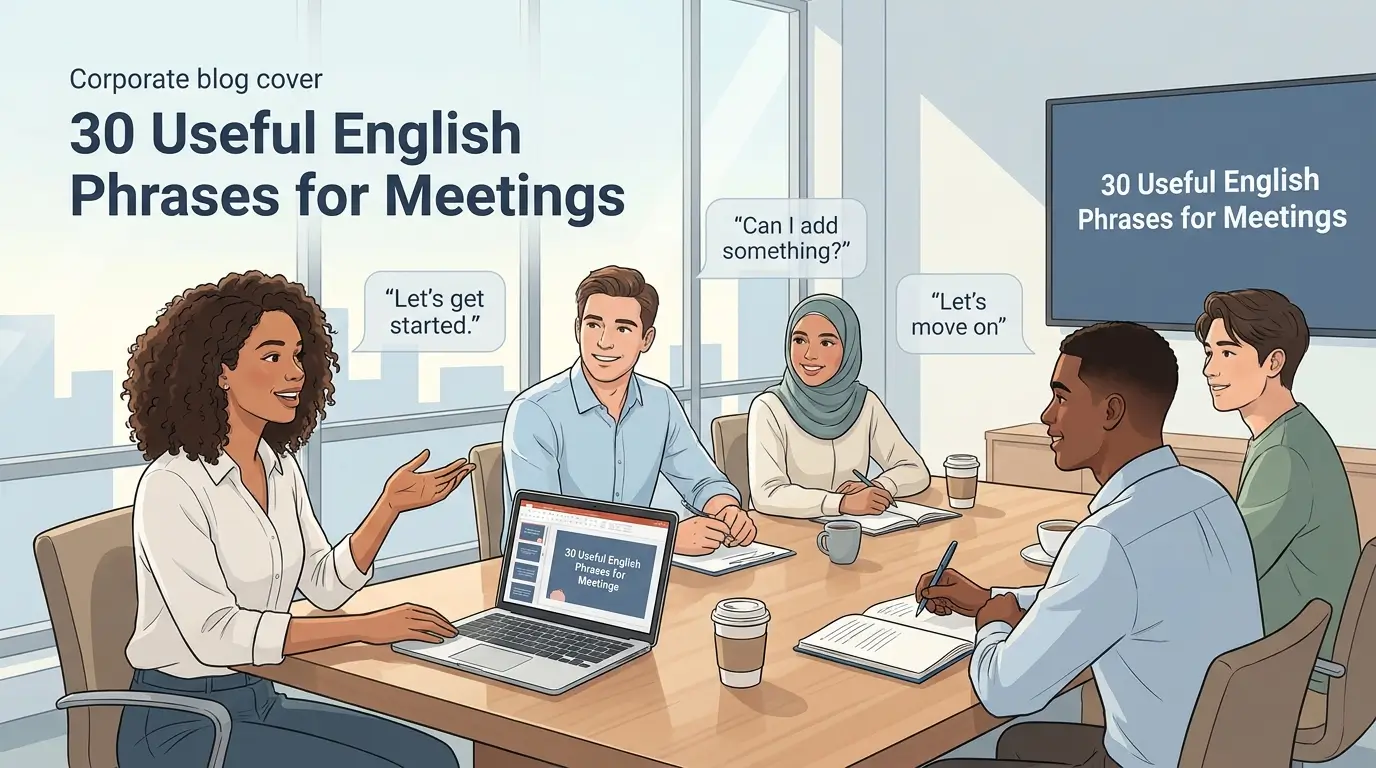
Speaking English in a meeting can feel like a completely different skill from speaking English in a classroom.
You might understand everything being said around the table, and then your turn comes, and the right words just... vanish. You want to ask a question without cutting someone off mid-sentence. You want to disagree without sounding like you're attacking the idea's author personally. Or maybe you just need to give a two-minute update and can't figure out how to open your mouth and start.
None of this actually requires advanced business English, which is the reassuring part.
A small set of practical phrases tends to cover most of what comes up. Once they're familiar, they start showing up almost automatically — when a meeting opens, partway through a discussion, and when it's time to wrap everything up.
This guide runs through 30 useful phrases for work meetings, with examples and plain explanations you can actually start using this week.
Why Meeting Phrases Matter
Meetings tend to follow a fairly predictable rhythm, whatever the actual topic ends up being. Someone opens things up, introduces the subject, people share ideas, questions surface, decisions get made, and eventually somebody brings it to a close.
Fig. 1 — The typical shape of a work meeting
Which means you're not really inventing a new sentence from scratch every time you speak — you're mostly reaching for a version of something that's come up a hundred times before.
A handful of ready-made expressions gives you somewhere reliable to start, and it tends to help you sound more confident too, particularly if English isn't the language you grew up speaking.
The main thing worth aiming for: short, clear, natural. None of this needs to sound like a corporate training video.
1. Starting a Meeting
The first couple of minutes set the tone for everything after. If you're the one leading, you need a simple way to welcome people and actually get things moving.
1. "Thanks everyone for joining." — Works to open an online or in-person meeting alike. Example: "Thanks everyone for joining. Let's get started."
2. "Shall we get started?" — A friendly, low-key way to signal it's time to begin. Example: "I think we're all here. Shall we get started?"
3. "Let's take a quick look at today's agenda." — Good for introducing what's actually on the table before diving in. Example: "Let's take a quick look at today's agenda before we begin."
4. "The main thing we need to discuss today is…" — Gets everyone oriented toward the actual purpose of the meeting. Example: "The main thing we need to discuss today is the new project deadline."
5. "We have quite a bit to cover today." — Useful whenever there are several items stacked on the agenda. Example: "We have quite a bit to cover today, so let's start with the first item."
2. Joining the Conversation
Sometimes you've got something worth saying, and the only real obstacle is figuring out how to actually get a word in. Waiting for some perfect silent gap rarely works — a short signaling phrase does the job better.
6. "Can I add something here?" — A natural way to bring in an extra idea. Example: "Can I add something here? I think we should also consider the customer's feedback."
7. "I'd like to make a quick point." — For a brief comment rather than a full explanation. Example: "I'd like to make a quick point about the budget."
8. "Can I jump in for a moment?" — Useful when the conversation's moving fast. Example: "Can I jump in for a moment? I have a slightly different suggestion."
9. "I'd like to mention one thing." — A simple way to flag an extra detail. Example: "I'd like to mention one thing before we move on."
10. "Before we move on, can I ask something?" — Works well when your question is tied to the current topic specifically. Example: "Before we move on, can I ask something about the delivery date?"
3. Giving Your Opinion
Repeating "I think..." for the fifth time in one meeting starts to sound a little flat. A few alternate phrases keep your speech from feeling stuck on repeat.
11. "From my perspective…" — For presenting a personal view. Example: "From my perspective, we need more time to test the product."
12. "I'd suggest…" — Recommending something without pushing too hard. Example: "I'd suggest speaking to the client before making a final decision."
13. "One option might be…" — Floats an idea without claiming it's the only answer. Example: "One option might be to move the launch to next month."
14. "My main concern is…" — For naming a potential problem directly. Example: "My main concern is the amount of time we have available."
15. "The way I see it…" — Introduces your own read on a situation. Example: "The way I see it, we have two realistic options."
4. Asking for Clarification
International meetings breed misunderstandings easily, especially once unfamiliar terms or a fast speaking pace enter the picture.
Asking for clarification isn't a weakness, whatever it might feel like in the moment — it tends to prevent a considerably bigger problem twenty minutes later.
16. "Could you clarify what you mean by that?" — For genuine uncertainty about someone's meaning. Example: "Could you clarify what you mean by 'a faster turnaround'?"
17. "Could you give me an example?" — When an explanation stayed too abstract to act on. Example: "I'm not completely clear on that. Could you give me an example?"
18. "Just to make sure I understand…" — For confirming before committing to an interpretation. Example: "Just to make sure I understand, you're asking us to finish this by Friday, correct?"
5. Asking Someone to Repeat or Slow Down
There's no need to pretend you caught everything. A short, direct request beats quietly guessing at what someone actually said.
19. "Could you say that again, please?" — Polite, simple, works almost everywhere. Example: "Sorry, I didn't catch the last part. Could you say that again, please?"
20. "Could you speak a little more slowly?" — For when someone's pace outruns your comprehension. Example: "Could you speak a little more slowly? I want to make sure I get the details right."
21. "I missed the last part." — Especially useful on a call where audio drops out mid-sentence. Example: "I missed the last part. Could you repeat the deadline?"
6. Disagreeing Politely
Disagreement is a completely normal part of a meeting that's actually going somewhere. The real challenge is expressing it without the other person hearing it as a personal attack.
Rather than "you're wrong," it tends to work better to aim the disagreement at the idea itself, or the evidence behind it.
22. "I see your point, but…" — Acknowledges the other view before shifting to yours. Example: "I see your point, but I'm concerned that the deadline may be too short."
23. "I'm not sure that would work in this situation." — A gentler version of just saying an idea is bad. Example: "I'm not sure that would work in this situation because we don't have enough staff."
24. "Could we consider another option?" — Opens the door to an alternative without shutting the current one down outright. Example: "Could we consider another option before making the final decision?"
7. Keeping the Meeting on Track
Conversations drift, and meetings are no exception. If keeping things moving happens to be your job that day, these phrases help.
25. "Let's come back to the main topic." — Redirects gently when the discussion has wandered. Example: "That's an interesting point. Let's come back to the main topic for now."
26. "We can come back to that later." — Acknowledges an issue without letting it hijack the whole meeting. Example: "That's worth discussing, but we can come back to that later."
27. "Let's move on to the next item." — Signals the current topic is actually done. Example: "If there are no more questions, let's move on to the next item."
8. Giving a Quick Work Update
Someone will eventually ask what you or your team have been doing. A genuinely useful update tends to cover three things: what's finished, what's happening now, and what's next — that structure alone keeps most updates from sprawling.
28. "Here's where things stand." — A clean way to open a progress update. Example: "Here's where things stand. We've finished the first draft and we're checking the final figures."
29. "We're still working on…" — For anything genuinely unfinished. Example: "We're still working on the final version of the report."
30. "The next step is…" — Makes clear what happens once the meeting ends. Example: "The next step is to send the proposal to the client."
Bonus: Useful Phrases for Ending a Meeting
The thirty phrases above cover most of what actually comes up, but closing a meeting well deserves its own small set too:
"Let's quickly recap what we've agreed." "Does anyone have anything else to add?" "I'll send a summary after the meeting." "Thanks everyone for your time." "Let's wrap things up here."
Confirming decisions and who owns what before people log off or leave the room tends to save everyone a round of confused follow-up emails later.
Common Mistakes English Learners Make in Meetings
Knowing the phrases is only half of it. How you actually use them shapes how confident you come across.
Apologizing Too Much
There's no need to announce, repeatedly, that your English isn't perfect. "Sorry, my English isn't very good. Sorry, could you repeat that?" says less than "Could you repeat the last point, please?" — shorter, and it reads as considerably more confident too.
Waiting for the Perfect Moment
If you hold out for a moment of total silence before speaking, that moment might just never come. "Can I add something here?" creates the opening yourself instead of waiting for one to appear.
Being Too Direct When Disagreeing
"That won't work" can land harder than intended, even when that's not the tone you meant. "I'm not sure that would work in this case" gets the same disagreement across while keeping the conversation constructive rather than combative.
Giving Too Much Background
When someone asks for an update, five minutes of context before the actual answer tends to lose the room. Starting with the current situation — "Here's where things stand. The report is almost finished, but we still need to check the figures" — and only adding detail if someone actually asks for it works considerably better.
How to Practice These Meeting Phrases
Reading these phrases is useful. Saying them out loud is where the actual practice starts.
Step 1: Choose Five Phrases
Trying to memorize all thirty at once is a reasonable way to remember none of them. Pick a handful that match situations you actually run into — something like: "Can I add something here?", "From my perspective…", "Could you clarify what you mean?", "I see your point, but…", "The next step is…"
Step 2: Create Your Own Examples
Don't just copy the examples straight from this article — build sentences tied to your actual work instead. In sales, maybe: "The next step is to contact the new leads." In marketing: "From my perspective, we should test the campaign first."
Personal examples tend to stick better, since they connect the vocabulary directly to a situation you'll actually be in again.
Step 3: Practice Speaking Aloud
Say each phrase a few times on its own. Then run through a short imagined meeting, alone or with a colleague: "Can I add something here?" "From my perspective, we need more time." "I see your point, but I have one concern." "The next step is to review the proposal."
It'll probably feel strange at first — that's completely normal, and it fades. The whole point is making these phrases easy to reach for under actual pressure, not just recognizable on a page.
Ending Thoughts
None of this requires advanced vocabulary to participate meaningfully in an English-language meeting.
What actually helps is a small set of reliable phrases that let you open a conversation, join a discussion mid-flow, ask a genuine question, explain your thinking, disagree without friction, and close your point cleanly.
Start with five phrases rather than all thirty at once. Use them in real meetings, adapt the examples to whatever you actually do for work, and add more only once the first batch feels automatic.
The goal was never to sound like a textbook. It's just to speak clearly enough that your actual ideas get heard.