Adverbs are small, unassuming words, and yet they can shift a sentence's whole meaning without anyone quite noticing why.
Compare "She speaks" with "She speaks clearly." The second version tells you something the first one simply doesn't — clearly explains how she speaks, and that one word changes what you picture.
This guide walks through what an adverb actually is, the main types worth knowing, where they tend to sit in a sentence, and a handful of mistakes worth watching for.
What Is an Adverb?
An adverb is a word that adds information about a verb, an adjective, another adverb, or sometimes an entire sentence.
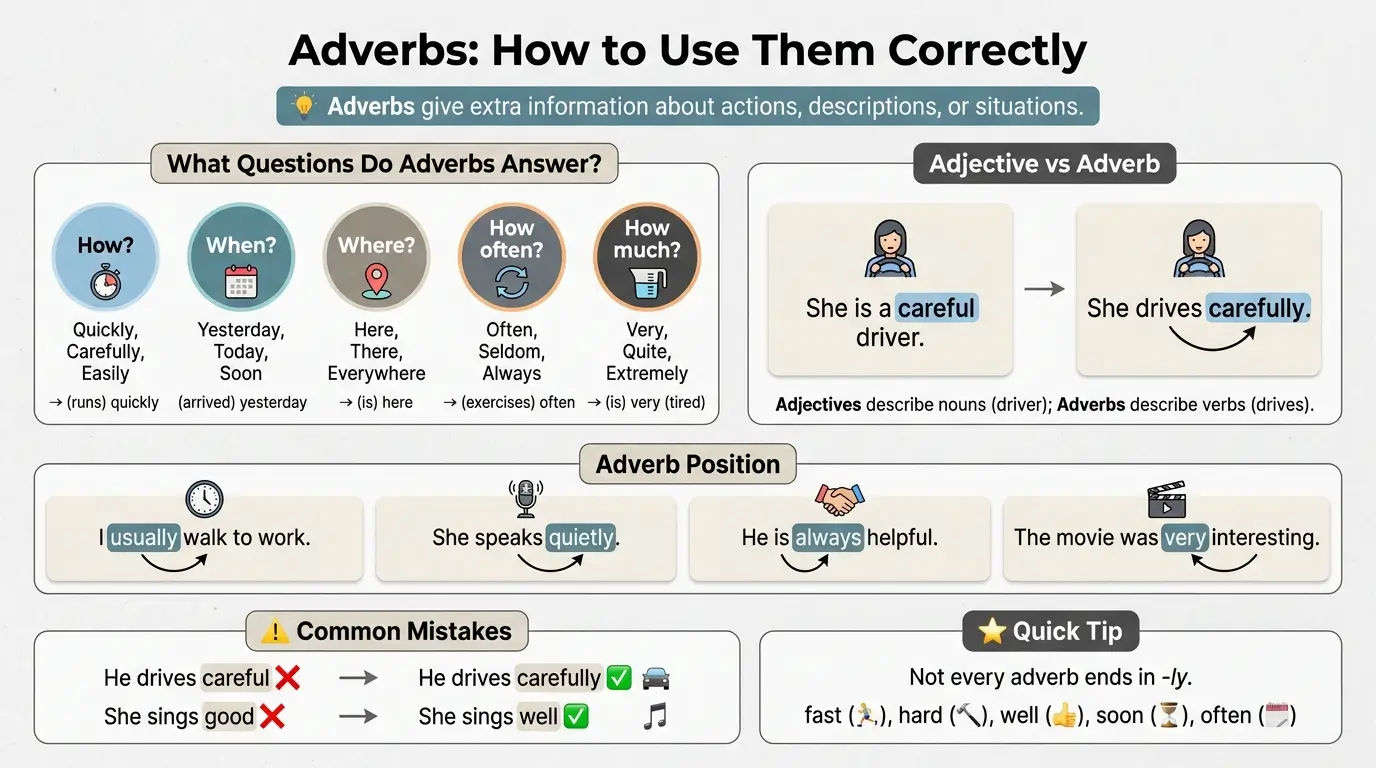
Adverbs can describe how something happens, when it happens, where it happens, how often it happens, or to what degree.
He drives carefully — how? We arrived yesterday — when? Please sit here — where? She often calls her parents — how often? The movie was very interesting — to what degree?
The simplest way to think about an adverb: it's whatever word is quietly adding extra information you'd otherwise be missing.
Examples of Adverbs in Sentences
A few everyday examples: she sings beautifully; he finished the work quickly; we will leave tomorrow; they live nearby; I usually drink coffee in the morning; the test was quite difficult.
Notice what the adverb actually contributes. "He answered" tells you what happened. "He answered politely" tells you something about how — information the first version simply left out.
Types of Adverbs
English has several categories of adverbs, and learning them by function tends to make them easier to spot in the wild.
1. Adverbs of Manner
These describe how an action happens: carefully, slowly, quickly, quietly, politely, badly, easily, happily.
"She completed the task carefully." "The children walked quietly into the room." "He answered the question correctly."
Plenty of manner adverbs end in -ly, but not all of them do. "He works hard." "She sings well." Neither hard nor well needs the -ly ending, so it's worth not assuming that suffix is a reliable test on its own.
2. Adverbs of Place
These tell you where something happens, or point to a direction or position: here, there, everywhere, outside, inside, upstairs, nearby, away.
"Please wait outside." "I looked everywhere for my keys." "Come here for a moment." "They went upstairs." Each one anchors the action somewhere specific.
3. Adverbs of Time
These tell you when something happens: today, yesterday, tomorrow, now, soon, later, recently, already.
"I finished the report yesterday." "We need to leave now." "She will call you later." "They arrived recently."
Adverbs of time usually land at the end of a sentence, though moving one to the front can shift the emphasis. "We will discuss the problem tomorrow" and "Tomorrow, we will discuss the problem" both work — the second just puts more weight on tomorrow specifically.
4. Adverbs of Frequency
These explain how often something happens: always, usually, often, sometimes, rarely, seldom, never.
"I usually walk to work." "She often reads before bed." "They sometimes eat out." "He never drinks coffee." Especially useful whenever the topic is routines or habits.
Placement: with most ordinary verbs, a frequency adverb usually sits before the main verb — "She always arrives early." "I often watch English videos." With the verb be, though, it moves after: "He is always polite." "They are usually busy on Mondays."
5. Adverbs of Degree
These tell you how much, or to what extent, something happens, or how strong a description really is: very, quite, too, extremely, almost, rather, really, enough.
"The coffee is very hot." "She was extremely tired." "The question was quite difficult." "He speaks really well." "We have almost finished."
These tend to sit right before an adjective or another adverb: "It is very cold" (very modifies cold), "She runs extremely quickly" (extremely modifies quickly, not runs directly).
6. Adverbs of Purpose or Reason
A smaller group of words and phrases explain why something happens: therefore, thus, consequently, so that, because of this.
"He missed the bus; therefore, he was late for work." "She left early so that she could catch the train." These show up mostly in formal writing, where connecting ideas logically matters more than it does in casual conversation.
Fig. 1 — The five questions adverbs answer
How Are Adverbs Formed?
Plenty of adverbs get built by adding -ly to an adjective: quick → quickly, careful → carefully, slow → slowly, quiet → quietly, polite → politely, happy → happily, easy → easily.
Some involve a small spelling shift — easy becomes easily, with the y turning into i before -ly.
Plenty of common adverbs skip -ly entirely, though: fast, hard, well, soon, often, never, here, there, today. Looking for the -ly ending is a reasonable first guess, but it's nowhere near a complete rule.
Adjective vs. Adverb
One of the more persistent problems for learners is picking the right one of these two.
An adjective usually describes a noun or pronoun. An adverb usually describes a verb.
"She is a careful driver" versus "She drives carefully" — careful describes driver, so it's an adjective; carefully describes drives, so it's an adverb.
Same pattern again: "He is a quiet person" versus "He speaks quietly." That one distinction — what's actually being described — tends to settle most of these cases on its own.
Where Should an Adverb Go in a Sentence?
Placement shifts depending on the type of adverb and what it's modifying. There's no single slot that works for all of them.
Adverb at the End
Adverbs of manner and place often land toward the end: "She smiled warmly." "The children are playing outside."
Adverb Before the Main Verb
Adverbs of frequency usually sit before the main verb: "I usually eat breakfast at home." "She often visits her parents."
Adverb After the Verb "Be"
"He is always helpful." "The children are sometimes noisy."
Adverb Before an Adjective
Adverbs of degree commonly sit right before the adjective: "The exam was very difficult." "The room is quite small."
Where exactly it lands often comes down to what you're actually trying to emphasize in that particular sentence.
Common Mistakes With Adverbs
Mistake 1 — Using an adjective instead of an adverb.
✗ He drives careful.
✓ He drives carefully.
The word's describing how he drives, so it needs to be an adverb.
Mistake 2 — Assuming every adverb ends in -ly.
✗ He runs fastly.
✓ He runs fast.
"Fast" already works as an adverb without any ending added.
Mistake 3 — Confusing "good" and "well."
✗ She sings good.
✓ She sings well.
"Well" describes how she sings. But "She is a good singer" is fine as written — there, "good" describes the noun "singer," not the verb.
Mistake 4 — Incorrect placement of frequency adverbs.
✗ I go always to the gym after work.
✓ I always go to the gym after work.
With ordinary verbs, frequency adverbs usually land before the main verb, not after it.
Adverbs in Everyday English
Adverbs probably show up in your own speech more than you'd guess. "I'll call you later." "I usually take the train." "Please speak slowly." "She is really good at English." "Come inside."
None of these are complicated sentences. The adverbs are just quietly doing the work of making each one more specific than the bare version would be — which is really the whole reason they're worth learning properly, for speaking and writing alike.
Quick Practice Exercise
Choose the correct word or identify the adverb:
- She completed the assignment ______. (a) careful (b) carefully (c) care
- I ______ go for a walk after dinner. (a) usually (b) usual (c) usefully
- Identify the adverb: The children are playing outside.
- Identify the adverb: He answered the question correctly.
- The movie was ______ interesting. (a) very (b) good (c) careful
Show Answers
1. carefully · 2. usually · 3. outside · 4. correctly · 5. very
Adverb Examples: Quick Reference
| Type of Adverb | Question | Examples |
|---|---|---|
| Manner | How? | slowly, carefully, well |
| Place | Where? | here, outside, nearby |
| Time | When? | today, soon, yesterday |
| Frequency | How often? | always, often, never |
| Degree | How much? | very, quite, extremely |
| Purpose/Reason | Why? | therefore, thus, so that |
Final Thoughts
Adverbs turn plain statements into something more specific, without needing to change much else about the sentence.
"The man spoke" becomes "The man spoke quietly," or "The man spoke yesterday," or even "The man often speaks quietly" — each version adds a slightly different layer of information on top of the same bare fact.
The easiest way to actually improve here is just noticing adverbs while reading or listening to ordinary English — where they land, what they're modifying, how they shift the sentence's meaning.
None of the rules need memorizing all at once. Start with the basic questions — how, when, where, how often, how much — and adverbs tend to become considerably easier to spot and use correctly from there.