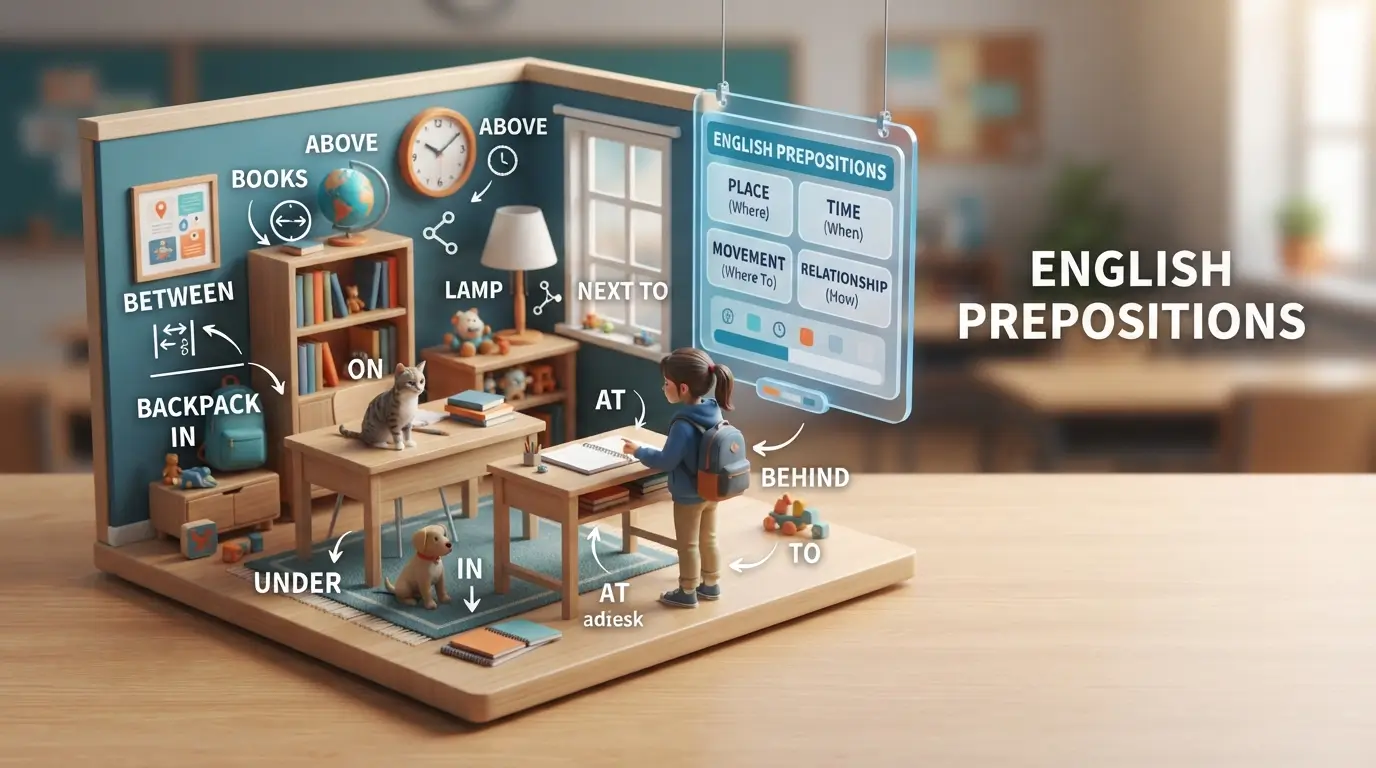
Prepositions are small, unassuming words, and yet English leans on them constantly to explain where something is, when it happens, where it's headed, or how two things actually connect.
Words like in, on, at, from, to, with, under, between, and about show up so often that they barely register — until you need the right one and suddenly none of them feel obviously correct.
"The keys are on the table." "She arrived at 9 a.m." "We walked to the station." "He is interested in photography." Each of these leans on a preposition doing quiet, essential work.
Getting a feel for prepositions tends to make speaking and writing sound considerably more natural. The catch: the same preposition can carry several different meanings depending on what surrounds it, so examples and repeated exposure usually teach this better than any single rule ever could.
What Is a Preposition?
A preposition is a word that shows the relationship between a noun or pronoun and some other part of a sentence.
The noun or pronoun following a preposition is usually called its object. In "The book is on the desk," on is the preposition and desk is its object. In "She went to the office," to connects the verb went with the noun office.
What Do Prepositions Show?
Prepositions can express several different kinds of relationship.
Place
They tell you where something's located: "The laptop is on the desk." "The shoes are under the bed." "She is waiting outside the building."
Time
They tell you when something happens: "The meeting starts at 10 a.m." "I was born in July." "We have a holiday on Friday."
Movement and Direction
They describe movement from one place to another: "He walked to the station." "She went into the room." "They drove through the tunnel."
Connection or Relationship
They can express something less physical too: "This letter is from my manager." "She is interested in science." "He works with children."
Fig. 1 — The four relationships prepositions show
Types of Prepositions
There are several ways to sort prepositions, but for everyday English, grouping them by the relationship they express tends to be the most useful approach.
1. Prepositions of Place
These tell you where someone or something is: in, on, at, under, over, above, below, beside, behind, between, near.
"The phone is on the table." "The cat is under the chair." "Sarah is standing beside her friend." "The bank is near the supermarket." "The picture is above the sofa."
In, On, and At
These three trip people up more than almost any other set of prepositions.
In tends to describe an enclosed space or a broader area: "She lives in London." "The documents are in the drawer."
On tends to describe a surface: "The keys are on the table." "There is a picture on the wall."
At tends to point at a specific location or point: "I'll meet you at the entrance." "She is at work."
The actual choice depends heavily on context, so learning whole phrases tends to work better than hunting for one universal rule that covers everything.
2. Prepositions of Time
These describe when something happens: at, on, in, before, after, during, since, until.
"The class begins at 8:30." "We have a meeting on Monday." "She moved here in 2022." "I usually exercise before breakfast." "They talked during the lunch break."
| Preposition | Common Use | Example |
|---|---|---|
| At | Specific times | at 7 p.m. |
| On | Days and dates | on Monday |
| In | Months, years, and longer periods | in August, in 2026 |
"The train leaves at 6:15." "The interview is on Tuesday." "He started the job in January."
3. Prepositions of Movement
These describe movement or direction: to, into, towards, through, across, around, along, past, up, down.
"We walked across the bridge." "She went into the kitchen." "The children ran towards the playground." "He walked past the library." "They drove through the city."
These words earn their keep especially when giving directions or describing a journey.
4. Prepositions of Relationship
Some prepositions describe relationships between people, objects, ideas, or activities: with, for, about, from, of, by.
"This present is for you." "She spoke with her manager." "We were talking about the new project." "This message is from John." "The report was written by the research team."
A preposition's meaning can shift depending entirely on what's sitting around it.
Common Prepositions List
| Category | Common Prepositions |
|---|---|
| Place | in, on, at, under, above, below, behind, near |
| Time | at, on, in, before, after, during, since, until |
| Movement | to, into, across, through, towards, around, along |
| Relationship | for, from, with, about, of, by |
Plenty of these words belong to more than one category — on covers both place and time depending on the sentence: "The phone is on the desk" versus "The meeting is on Monday."
Multi-Word Prepositions
Some prepositions run longer than one word — these get called compound or multi-word prepositions: because of, in front of, next to, according to, instead of, on top of, in addition to.
"The car is parked in front of the house." "We canceled the picnic because of the rain." "She sat next to me." "According to the report, sales increased this year."
These show up constantly in both everyday and professional English.
Prepositions and Common Word Combinations
One reason prepositions frustrate learners specifically: certain words simply pair with a particular preposition, for reasons that don't always make obvious sense.
Interested in. Good at. Afraid of. Responsible for. Familiar with. Worried about.
"She is interested in photography." "He is good at mathematics." "I'm worried about the interview." "They are responsible for the project."
There isn't always a tidy explanation for why one preposition wins over another. Usually the more efficient approach is learning the whole combination as a single unit, rather than trying to reason your way to the correct preposition from the word alone.
Common Preposition Mistakes
Mistake 1 — Confusing "in" and "on."
✗ The book is in the table.
✓ The book is on the table.
Something resting on a surface normally takes "on."
Mistake 2 — Using the wrong time preposition.
✗ I was born on 1998.
✓ I was born in 1998.
Years generally pair with "in."
Mistake 3 — Confusing "at" and "to."
✗ She arrived to the airport.
✓ She arrived at the airport.
"Arrive" tends to take "at" for specific places and "in" for cities or countries — "We arrived at the hotel" versus "We arrived in Paris."
Mistake 4 — Forgetting a necessary preposition.
✗ He is interested photography.
✓ He is interested in photography.
Certain adjectives and verbs simply require a specific preposition to follow them — skipping it leaves the sentence sounding incomplete.
Can a Sentence End With a Preposition?
Yes, and it's perfectly natural in plenty of situations.
"Who are you talking to?" is entirely ordinary in everyday English. A more formal version, "To whom are you talking?", is grammatically fine too, just considerably stiffer for casual conversation.
The old rule insisting sentences must never end with a preposition doesn't really describe how modern English actually gets spoken or written — it's more a leftover style preference than an actual grammar law.
Preposition Examples in Everyday English
Prepositions turn up almost everywhere in ordinary conversation: "I'll see you at the office." "The meeting is in the afternoon." "Please put the documents on my desk." "She walked into the room." "We talked about the new project." "He has worked here since 2021."
Simple sentences, all of them — but the prepositions are doing the quiet work of making the relationships between ideas actually clear.
How to Learn Prepositions More Easily
Prepositions tend to stick better as part of a complete expression than as an isolated fact.
Rather than memorizing "interested = in," it helps more to learn "interested in something" as one unit. Rather than "responsible = for," learn "responsible for something."
Keeping a running list of phrases picked up from reading, videos, or conversation helps too — paying attention specifically to the preposition, not just the main word: good at, depend on, listen to, afraid of, interested in.
Given enough exposure, these combinations tend to start feeling automatic rather than memorized.
Quick Practice Exercise
Choose the correct preposition:
- The meeting starts ___ 9 a.m. (a) on (b) at (c) in
- She was born ___ March. (a) at (b) on (c) in
- The keys are ___ the kitchen table. (a) on (b) at (c) to
- He is interested ___ learning English. (a) on (b) in (c) at
- They walked ___ the bridge. (a) across (b) at (c) in
Show Answers
1. at · 2. in · 3. on · 4. in · 5. across
Frequently Asked Questions
What is a preposition?
A preposition is a word that shows a relationship between a noun or pronoun and another part of a sentence.
What are some common prepositions?
Common examples include in, on, at, to, from, for, with, by, under, over, between, and about.
What are the main types of prepositions?
The most useful categories for everyday English are prepositions of place, time, movement, direction, and relationship.
Why are prepositions difficult to learn?
Many prepositions carry several meanings, and certain words naturally pair with a specific preposition regardless of logic. Context tends to matter more than any fixed rule.
Can a sentence end with a preposition?
Yes. Ending a sentence with a preposition is common and entirely natural in modern English.
Small Words, Big Difference
Prepositions are short, but they carry a surprising amount of meaning for their size. A small shift from in to on, or at to to, can quietly change the entire relationship a sentence is describing.
Memorizing a long list was never really the most efficient way to learn them. Noticing how prepositions get used inside complete, real sentences, learning the common word combinations as units, and actually practicing them in your own speaking and writing tends to work considerably better.
With enough exposure, expressions like interested in, good at, on Monday, and at work gradually stop requiring conscious thought — they just start arriving correctly, without you stopping to check a rule first.