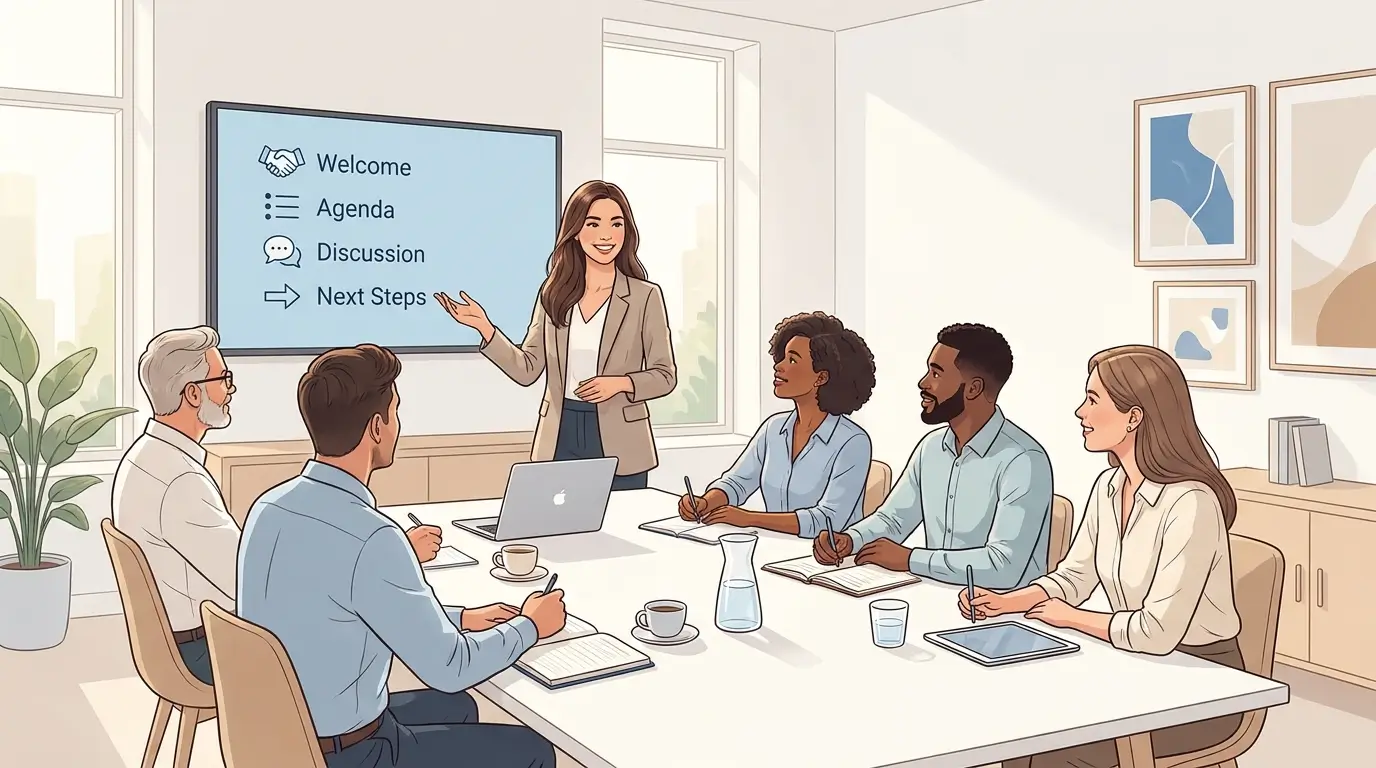
The first few minutes of a meeting tend to set the tone for everything that follows, more than people usually give them credit for.
Start too casually, and the room can lose track of why it's even gathered. Start too abruptly, and things can feel tense before anyone's said a word. The sweet spot sits somewhere in between — people get a moment to settle, but everyone also picks up on when it's actually time to focus.
This matters more, not less, when English isn't your first language. A simple structure and a handful of prepared phrases can make opening a meeting feel considerably less like a performance.
Whether you're leading a team meeting, joining a client call, or just sitting in on an online meeting that happens to run in English, the approach below should help you start without sounding stiff or oddly formal.
Prepare Before the Meeting Begins
A meeting that actually goes well usually starts working before anyone's even joined the call.
A few minutes spent answering some fairly basic questions helps: what's the actual purpose here? What needs discussing? Who genuinely needs to be in the room? What should people bring with them? How much time does this realistically need? And what decision or outcome should come out the other side?
If the purpose can't be summed up in a sentence or two, the agenda's probably still a little vague. "Project meeting" tells nobody anything. "Review the current project timeline, discuss the testing delay, and agree on the revised launch date" gives people something they can actually prepare for.
Share the Agenda in Advance
An agenda doesn't need to be elaborate — a short numbered list usually does the job: project progress, current problems, budget update, next steps, questions.
Sending it out beforehand means people walk in already knowing roughly what's coming, instead of spending the first ten minutes figuring that out live.
Start the Meeting on Time
It's tempting to hold off for one more person, and occasionally that's genuinely the right call — particularly if the missing person is central to the discussion. Making a habit of it, though, tends to erode punctuality for everyone else fairly quickly.
Starting on time sends a fairly simple message: everyone's time actually matters here.
Something as plain as "Good morning, everyone. Thanks for joining. Let's get started" covers it. If someone's still missing: "I think we're ready to begin. We'll catch up anyone who joins us later." No lengthy preamble required.
Use a Short Opening
A decent opening tends to do three things in sequence: welcome people, explain the purpose, introduce the agenda.
"Thanks, everyone, for joining. Today I'd like to review our progress, discuss the remaining issues, and agree on the next steps" — that's genuinely enough to point everyone in the right direction.
For something more informal, a quick personal check-in can precede the main event: "How's everyone doing today? Great. Let's take a quick look at what we need to cover."
Worth watching, though: a few minutes of friendly chat is fine, even useful for building rapport, but it shouldn't accidentally become the meeting itself.
Introduce the Main Topic Clearly
Once everyone's welcomed, it's time to actually say what the meeting's about.
A few phrases worth keeping ready: "The main purpose of today's meeting is…" "Today we're going to focus on…" "I'd like us to leave this meeting with a clear decision on…" "There are three things I'd like us to cover today."
These tend to matter a lot for English learners specifically, since they hand you a ready-made structure rather than requiring you to invent one on the spot.
"So, we have some things to discuss about the project…" is vague enough to leave people guessing. "Today we're focusing on the project timeline, the remaining technical issues, and the launch date" tells them exactly what to expect, in roughly the same number of words.
Give People a Chance to Contribute
A meeting isn't really a presentation, or shouldn't be, even when one person happens to be leading it.
Once a topic's introduced, it's worth actively inviting others in: "Sarah, could you give us a quick update?" "James, what are you seeing from the sales side?" "Does anyone have anything they'd like to add?"
Worth remembering too: not everyone processes and responds the same way. Some people jump in immediately; others need a beat to think before speaking. A meeting that only rewards the fast talkers tends to miss whatever the quieter ones were actually thinking.
Keep the Conversation Moving
Even a carefully planned meeting can wander off without anyone quite noticing.
Someone raises an interesting tangent. That leads somewhere else entirely. Someone remembers an unrelated problem from last week. Twenty minutes later, the original agenda item hasn't moved an inch.
There's no need to shut anyone down bluntly. Acknowledging the point while redirecting tends to work better: "That's worth discussing. Let's come back to it after we've covered this item." Or: "Let's keep that as a separate topic for now." If it genuinely needs real time: "I think we need more time to discuss that properly. Let's put it on the agenda for our next meeting."
None of these phrases sound rude. They just protect the meeting's actual shape.
Watch the Time
Not every agenda item deserves equal airtime. Some genuinely need more discussion than others — the problem shows up when one issue quietly eats the entire meeting.
A gentle nudge usually fixes this: "We have about ten minutes left, so let's focus on the decision we need to make." Or: "We've spent quite a bit of time on this. Can we agree on the next step and move forward?"
A time reminder isn't a criticism of anyone. It's just protecting whatever's still left on the agenda.
Give the Meeting Clear Roles
Larger meetings tend to run smoother once people know who's actually responsible for what.
Meeting Leader
Guides the discussion, introduces topics, manages the clock, and generally keeps the group moving toward whatever the meeting's actually there to accomplish.
Note-Taker
Records the decisions, the responsibilities, and the deadlines — someone needs to, since memory alone tends to produce three slightly different versions of what was actually agreed.
Participants
Come prepared, contribute where it's relevant, and leave understanding what they're now responsible for.
None of these roles need to be formal or announced. In a small team meeting, one person often ends up covering all three without anyone assigning it explicitly.
Encourage Balanced Participation
One of the fastest ways a meeting turns unproductive is a single voice dominating the entire conversation.
If that's happening, a leader can redirect gently: "Thanks, David. I'd also like to hear what the rest of the team thinks." Or: "We've heard one perspective. Does anyone see it differently?"
This matters especially around actual decisions — a different perspective can surface a problem that the dominant voice simply didn't notice.
That said, balanced participation doesn't mean forcing every single person to weigh in on every single item. The goal is a useful discussion, not attendance credit.
Deal With Distractions and Side Discussions
Phones, notifications, an unrelated question, a private side conversation — any of these can break the room's concentration fast.
Online meetings bring their own version of this: someone's connection drops, background noise creeps in, three other tabs are quietly open. When the discussion starts sliding off-topic, a calm redirect works: "Let's get back to the original question." "That's a separate issue, so let's park it for now." "I'd like to keep us focused on today's objective."
The language here is about as simple as it gets, but it tends to change the pace of a meeting more than people expect.
End With Clear Action Points
A meeting probably shouldn't end with people quietly wondering, "so what actually happens now?"
Before wrapping up, it's worth confirming: what got decided, what's still outstanding, who owns it, when it's due, and whether another meeting needs scheduling.
"Before we finish, let's confirm the next steps" opens it. "Maria will update the report by Thursday, James will contact the supplier, and I'll send the revised schedule tomorrow" closes the loop — no ambiguity left hanging.
Follow Up After the Meeting
A short follow-up message can prevent a surprising number of misunderstandings, and it doesn't need to be long.
A written record like that matters especially for remote teams, where people can walk away from the exact same conversation with genuinely different impressions of what was agreed.
Common Meeting Mistakes to Avoid
No Clear Purpose
If people don't actually know why they're there, the conversation drifts almost by default.
An Overloaded Agenda
Fifteen major items squeezed into thirty minutes tends to produce rushed decisions nobody's fully comfortable with.
Starting Late
Repeatedly waiting for latecomers quietly wastes the time of everyone who actually showed up on schedule.
Letting One Person Dominate
Meetings work better when the people who actually have something relevant to say get genuine room to say it.
No Clear Responsibilities
If nobody's sure who's doing what afterward, the discussion risks staying just that — a discussion, with no real follow-through.
Ending Without a Summary
A short recap at the end tends to surface misunderstandings while they're still cheap to fix, rather than after everyone's already left.
Useful English Phrases for Starting a Meeting
Worth keeping a few of these on hand so you're not reconstructing every sentence from nothing in the moment.
To welcome people: "Thanks everyone for joining." "It's good to see everyone."
To begin: "Let's get started." "I think we're ready to begin."
To explain the purpose: "The main purpose of today's meeting is…" "Today I'd like to focus on…"
To introduce the agenda: "We have three main points to cover." "Let's start with the first item."
To invite participation: "What do you think?" "Would you like to add anything?"
To move forward: "Let's move on to the next point." "We can come back to that later."
To finish: "Let's quickly review the next steps." "Thanks, everyone. That covers everything for today."
A Simple Meeting Structure You Can Reuse
If leading a meeting in English feels a little nerve-wracking, this five-step structure tends to hold up well:
Fig. 1 — A reusable five-step meeting structure
1. Welcome — "Good morning, everyone. Thanks for joining."
2. Purpose — "Today we're going to discuss the new project timeline."
3. Agenda — "We'll first review our progress, then discuss the current problems and agree on the next steps."
4. Discussion — "Let's start with the progress update. Sarah, could you take us through it?"
5. Wrap-up — "Before we finish, let's confirm the action points."
Simple enough for a first attempt, flexible enough to keep using once meetings stop feeling quite so nerve-wracking.
Practical Tips for Better Meetings
None of this requires impressive vocabulary or elaborate business expressions. What actually matters more is a clear purpose, respect for people's time, room for real discussion, and clarity about what happens once everyone logs off.
If English is your second language, prepare a few phrases beforehand. Write down whatever questions you plan to ask. Say your opening line out loud once or twice before the call starts — even two or three minutes of rehearsal tends to make the first moments feel considerably less daunting.
Above everything else: don't wait for flawless English before actually participating. Meetings are exactly the kind of place where practical language ability develops through use, not before it.
Start simply. Speak clearly. Focus on getting the actual message across.