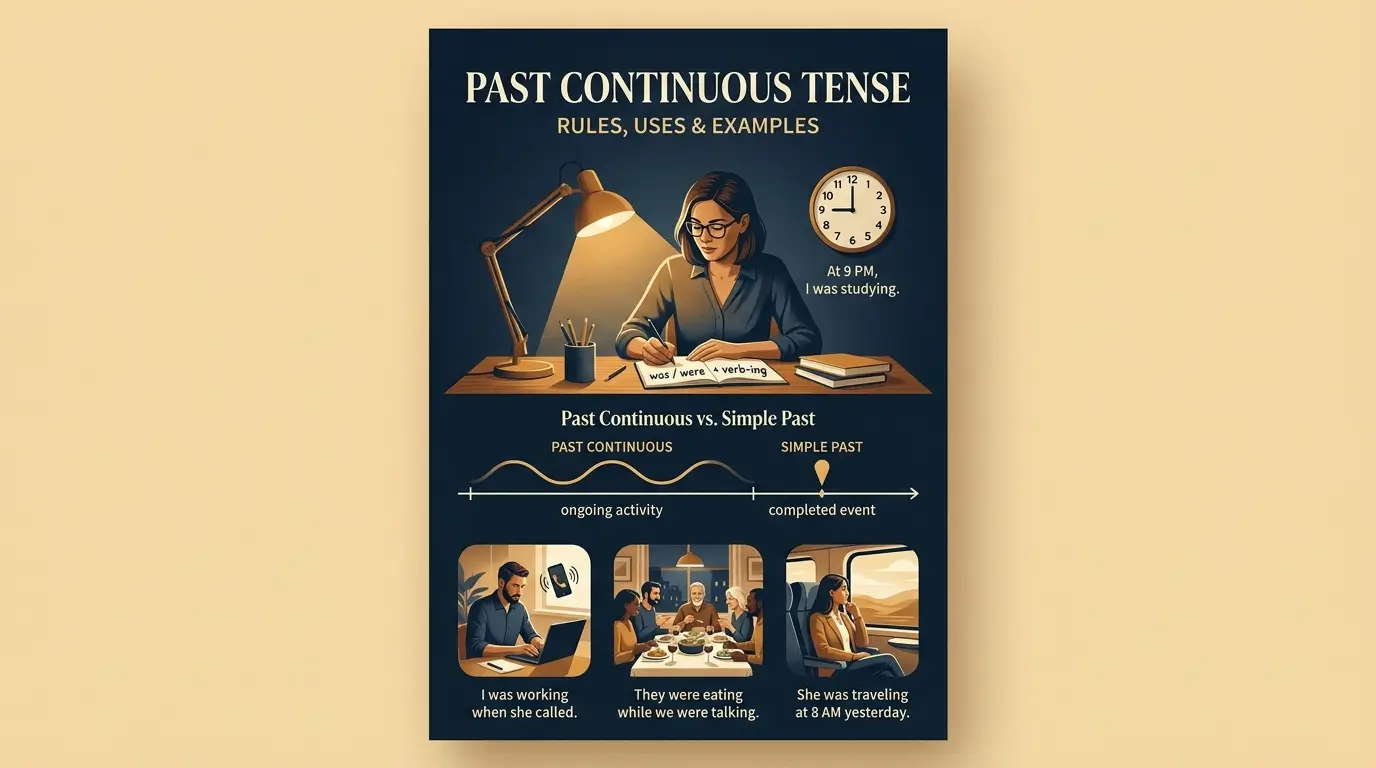
The past continuous — sometimes called the past progressive — does something the past simple can't do on its own: it lets you step inside a past moment and describe what was already in motion there.
"I was working at 8 p.m." "She was reading when I called." "They were having dinner when the lights went out." In each of these, a past simple sentence could tell you an event happened; the past continuous tells you what the background looked like, what was already running when that event arrived.
Understanding that distinction — process versus completed event — is most of what there is to learn here.
What Is the Past Continuous Tense?
The past continuous describes an action or situation that was ongoing at a particular point in the past. The action typically started before the moment being discussed and may have continued afterward. What matters is that it was in progress at that time.
"At 9 o'clock, I was studying" — studying was already in motion at that moment. Contrast that with "I studied at 9 o'clock," which presents the action as a completed event. Same time, different angle on what's being communicated.
Past Continuous Tense Formula
The structure: subject + was/were + verb-ing.
| Subject | Helping Verb | Example |
|---|---|---|
| I / He / She / It | was | She was reading. / It was raining. |
| You / We / They | were | We were traveling. / They were talking. |
Was goes with I, he, she, and it. Were goes with you, we, and they — including when you refers to a single person.
Fig. 1 — Past continuous tense structure at a glance
Forming the -ing Verb
Most verbs: add -ing directly — work → working, read → reading, play → playing.
Verbs ending in silent -e: drop the e first — write → writing, make → making, drive → driving.
Verbs ending in -ie: change to y — lie → lying, die → dying.
Short consonant-vowel-consonant verbs: double the final consonant — run → running, sit → sitting, stop → stopping. (Note: British English uses "travelling," American English uses "traveling.")
Positive, Negative, and Questions
Positive
"I was preparing dinner." "She was working on an email." "We were discussing the project." "They were waiting outside."
Negative
Add not after was or were: "I was not sleeping." "She wasn't listening." "We weren't watching television." "They weren't waiting for us."
Contractions: was not → wasn't, were not → weren't.
Yes/No Questions
Move was or were before the subject: "Was she working?" "Were they waiting?" Short answers: "Yes, I was." / "No, I wasn't." "Yes, they were." / "No, they weren't."
Wh-Questions
"What were you doing?" "Where was she going?" "Why were they laughing?" "Who was he talking to?"
When Do We Use the Past Continuous?
1. An Action in Progress at a Specific Past Time
The clearest use: something was happening at a named moment.
"At 8 p.m., I was attending an online meeting." "This time last year, we were living in another city." "At lunchtime, she was speaking with her manager."
The focus is on the activity being in progress — not on whether it finished.
2. An Interrupted Action
Probably the most common use in everyday English. The longer ongoing action takes the past continuous; the shorter event that breaks into it takes the simple past.
"I was watching television when the phone rang." "She was walking home when it started to rain." "They were having dinner when the electricity went out."
The order can flip without changing the meaning: "When the phone rang, I was watching television." The ongoing action always provides the background; the simple past delivers the interruption.
3. Two Simultaneous Actions
When two activities were happening at the same time, both can take the past continuous.
"She was reading while he was cooking." "I was working while my colleague was preparing the presentation." "The children were playing while their parents were talking."
While is the natural connector here.
4. Background in a Story
The past continuous sets the scene before the main event arrives.
"The rain was falling, the wind was blowing, and people were rushing home. Suddenly, the lights went out." The continuous actions build the backdrop; the simple past introduces what actually happens.
This is a genuinely useful technique for making written descriptions and personal stories feel less flat.
5. Gradual Change in the Past
"The weather was getting colder." "The city was growing rapidly." "Her English was improving." "The situation was becoming more difficult."
The continuous form here highlights the process of change rather than its endpoint.
6. Polite or Tentative Expressions
The past continuous can soften a request or make it feel less direct.
"I was wondering if you could help me." "I was hoping you might have some advice." These are common in both professional and everyday conversation.
Past Continuous vs. Simple Past
| Past Continuous | Simple Past |
|---|---|
| Action in progress at a past moment | Completed past action |
| Background / setting | Main event |
| Common with while, as | Common with when (interrupting event) |
| was/were + verb-ing | Past form of verb |
"I was cooking when my friend called" — cooking was in progress; the call interrupted it. "I cooked dinner and watched a movie" — both are completed events in sequence. The two tenses frequently work together: "While I was walking home, I saw an old colleague." The walking provides the background; seeing the colleague is the specific event.
Common Time Expressions
| Expression | Example |
|---|---|
| at + specific time | At 7 p.m., I was exercising. |
| while | While I was studying, he was sleeping. |
| when | I was leaving when you called. |
| as | As I was opening the door, the phone rang. |
| all morning / all day | She was working all morning. |
| this time yesterday | I was flying home this time yesterday. |
Stative Verbs and the Past Continuous
Verbs describing states rather than ongoing activities — know, believe, understand, want, need, like, love, hate, own, prefer — are generally not used in continuous forms.
✗ I was knowing the answer.
✓ I knew the answer.
✗ She was preferring the first option.
✓ She preferred the first option.
Some verbs can shift meaning depending on use. Think can describe an opinion ("I think you're right") or an active process ("I was thinking about the problem when you called"). Have can describe possession or an activity ("He was having lunch"). Context matters more than a memorized list.
Common Mistakes
Mistake 1 — Wrong form of be.
✗ She were sleeping.
✓ She was sleeping. I/he/she/it → was. You/we/they → were.
Mistake 2 — Forgetting -ing.
✗ I was work at home.
✓ I was working at home.
Mistake 3 — Spelling error with doubled consonant.
✗ He was runing.
✓ He was running.
Mistake 4 — Using past continuous for the interrupting event.
✗ I was walking home when it was starting to rain.
✓ I was walking home when it started to rain. The interrupting event takes the simple past.
Mistake 5 — Stative verb in continuous form.
✗ I was knowing the answer.
✓ I knew the answer.
Practice Exercises
Exercise 1: Complete with the correct past continuous form:
- At 9 p.m., I ________ on my computer. (work)
- She ________ when I called her. (read)
- They ________ to the instructions. (not / listen)
- We ________ home when it started raining. (drive)
- ________ you ________ at midnight? (sleep)
- He ________ dinner while his wife was working. (prepare)
- The children ________ outside when it became dark. (play)
- Why ________ she ________? (cry)
Show Answers
1. was working · 2. was reading · 3. weren't listening · 4. were driving · 5. Were / sleeping · 6. was preparing · 7. were playing · 8. was / crying
Exercise 2: Choose the correct answer:
- At 8 p.m., I ________ dinner. (A) cooked (B) was cooking (C) cook
- She was walking home when it ________. (A) rained (B) was raining (C) rain
- They ________ television while we were studying. (A) watched (B) were watching (C) watch
- He ________ sleeping when the alarm rang. (A) was (B) were (C) is
- ________ you working when I called? (A) Was (B) Were (C) Did
Show Answers
1. B · 2. A · 3. B · 4. A · 5. B
Quick Reference
| Use | Structure | Example |
|---|---|---|
| Action in progress | was/were + verb-ing | I was working. |
| Interrupted action | continuous + when + simple past | I was working when he called. |
| Two simultaneous actions | while + continuous | She was cooking while I was studying. |
| Story background | was/were + verb-ing | The rain was falling. |
| Gradual change | was/were + verb-ing | The weather was getting colder. |
| Polite request | was + verb-ing | I was wondering if you could help. |
Frequently Asked Questions
What is the past continuous tense?
The past continuous describes an action or situation that was in progress at a particular time in the past.
What is the formula for the past continuous?
Subject + was/were + verb-ing. "She was reading." "They were working."
When do we use the past continuous?
For actions in progress at a past time, interrupted actions, simultaneous activities, story backgrounds, gradual changes, and polite expressions.
What is the difference between past continuous and simple past?
The past continuous shows an action in progress; the simple past presents a completed event. They often work together: "I was cooking when she arrived."
When should I use was and were?
Was goes with I, he, she, and it. Were goes with you, we, and they.
Which verbs are not normally used in the past continuous?
Stative verbs — know, believe, understand, want, need, like, love, own, prefer — are generally not used in continuous forms.
Can the past continuous describe two simultaneous actions?
Yes. "I was studying while my sister was watching television."
The Background That Makes Events Make Sense
The past continuous is really the tense of context. It doesn't just record what happened — it shows what was already running when something happened, and that distinction makes stories, explanations, and descriptions considerably clearer.
Start with the core pattern: was/were + verb-ing. Then build the interrupted-action combination — past continuous + when + simple past — until it comes naturally. From there, the other uses tend to follow without much effort. Describe what you were doing last night, what was happening when something interrupted it, and what two things were going on at the same time. That kind of real-context practice tends to fix the tense in memory faster than exercises alone ever do.