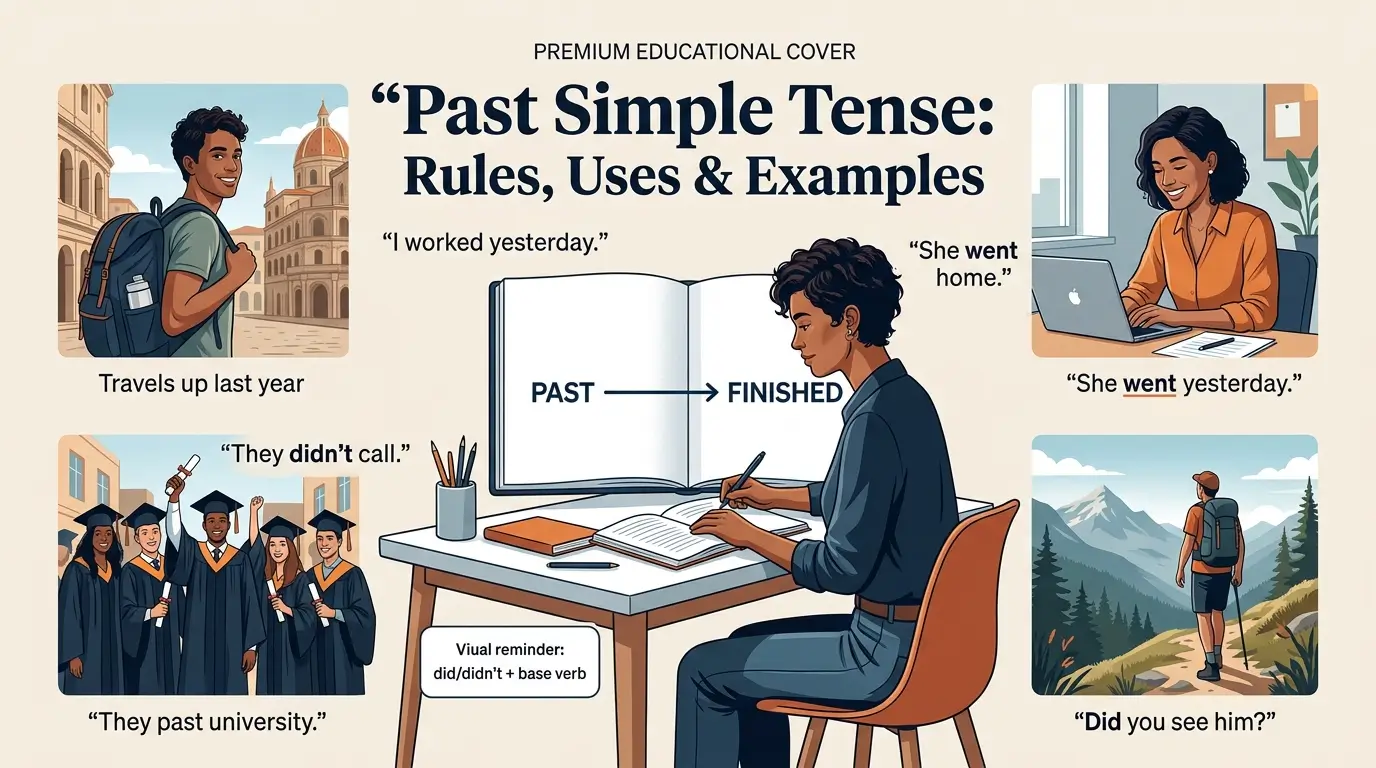
The past simple is one of the first tenses English learners encounter, and one of the last they fully feel comfortable with. The structure itself isn't complicated. What takes time is the irregular verbs, the base-form rule after did and didn't, and the instinct for which past time expressions tend to pull this tense into play.
Used constantly in real conversation — telling stories, describing previous experiences, explaining what happened yesterday, recounting anything from a job interview to a weekend trip — the past simple is worth getting right.
"I visited my friend yesterday." "She finished the report last night." "They went to a restaurant on Saturday." In each, the action is viewed as finished and closed in the past. That's the core idea.
What Is the Past Simple Tense?
The past simple describes an action, event, or situation that started and ended in the past. The action could have happened yesterday or twenty years ago — what matters is that it's viewed as complete and no longer ongoing.
"I called my manager yesterday." "He graduated from university in 2022." "We moved to this city three years ago." "She worked at that company for five years before leaving."
The tense becomes particularly natural when the speaker names a definite, finished past time — yesterday, last week, in 2019, on Monday, when I was a child. That kind of time expression signals clearly that the event belongs to the past.
Past Simple Tense Structure
Affirmative sentences follow: subject + past form of the verb + rest of sentence.
| Subject | Past Verb | Example |
|---|---|---|
| I | worked | I worked yesterday. |
| She | called | She called me last night. |
| He | went | He went home early. |
| They | visited | They visited us last weekend. |
| We | watched | We watched a documentary. |
The past form depends on whether the verb is regular or irregular — which is where most of the difficulty actually lives.
Fig. 1 — Past simple tense structure at a glance
Regular Verbs in the Past Simple
Most regular verbs form the past simple by adding -ed: work → worked, talk → talked, clean → cleaned, open → opened, watch → watched.
A few spelling adjustments apply depending on the verb's ending.
Verbs Ending in -e
Add only -d, not -ed: live → lived, create → created, change → changed, close → closed.
Verbs Ending in Consonant + y
Change y to i and add -ed: study → studied, try → tried, carry → carried. If the letter before y is a vowel, just add -ed: play → played, enjoy → enjoyed.
Doubling the Final Consonant
Some short verbs ending in a consonant-vowel-consonant pattern double the final consonant before -ed: stop → stopped, plan → planned, shop → shopped. Longer verbs can also double when the final syllable is stressed: prefer → preferred.
These spelling patterns take some practice. Working with common examples tends to be more useful than trying to memorize every rule at once.
Irregular Verbs in the Past Simple
Irregular verbs don't add -ed. Their past forms change in their own ways, and they need to be learned individually.
| Base Verb | Past Simple | Example |
|---|---|---|
| go | went | She went to work early. |
| eat | ate | I ate breakfast before the meeting. |
| see | saw | We saw him at the conference. |
| write | wrote | He wrote the proposal last week. |
| take | took | They took the train. |
| buy | bought | I bought a new laptop. |
| come | came | She came home late. |
| speak | spoke | He spoke to his manager yesterday. |
There's no shortcut here — frequent use and reading are what make these forms stick.
Negative Sentences in the Past Simple
Structure: subject + did not / didn't + base verb.
The single rule worth fixing firmly: after didn't, the main verb returns to its base form. Did already carries the past meaning, so the main verb doesn't need to change.
"I didn't finish the report." "She didn't call me yesterday." "He didn't go to work." "We didn't watch the game." "They didn't understand the question."
✗ She didn't went home.
✓ She didn't go home.
The full form "did not" is correct and can work when emphasizing a denial: "I did not send that email." In everyday conversation, "didn't" is generally more natural.
Yes/No Questions in the Past Simple
Structure: Did + subject + base verb?
"Did you call Sarah?" "Did he finish the project?" "Did they enjoy the trip?" "Did she arrive on time?"
Same rule applies: the verb after did stays in its base form.
✗ Did you went there?
✓ Did you go there?
Short Answers
"Did you finish the report?" → "Yes, I did." / "No, I didn't."
"Did she call you?" → "Yes, she did." / "No, she didn't."
"Did they attend the meeting?" → "Yes, they did." / "No, they didn't."
Wh-Questions in the Past Simple
Structure: Wh-word + did + subject + base verb?
"Where did you go yesterday?" "When did she start the job?" "Why did he leave early?" "What did they buy?" "How long did the journey take?" "Why didn't you tell me?"
This pattern is particularly useful when asking someone to explain or describe a past event in more detail.
When to Use the Past Simple
1. Completed Actions in the Past
The clearest use. An action that's finished, full stop.
"I finished my assignment last night." "She called the client yesterday." "We visited our relatives last weekend." "He closed the shop at 8 p.m."
2. Past Habits and Routines
The past simple can describe regular activities that belonged to an earlier period — things that no longer happen.
"I walked to school every morning when I was a child." "She played tennis every weekend at university." "We visited our grandparents every summer when I was growing up."
Context usually signals clearly that the routine is past rather than current.
3. A Sequence of Past Events
For telling a story or explaining events in order, several past simple verbs follow each other naturally.
"I woke up, made coffee, checked my emails, and left for work." "She entered the room, greeted everyone, and sat near the window."
That sequence of completed actions is one of the most common uses in everyday storytelling.
4. Historical Events and Past Facts
Events and facts that belong fully to the past take the past simple.
"The company opened its first office in 1998." "He graduated from university in 2015." "The Romans built roads across much of Europe."
5. Actions With a Definite Past Time
When a sentence names exactly when something happened, the past simple is almost always the appropriate choice.
"I moved here in 2021." "She started her new job last month." "They bought the house two years ago." "We met on Monday."
Common Past Simple Time Expressions
| Expression | Example |
|---|---|
| yesterday | I called him yesterday. |
| last night | She cooked dinner last night. |
| last week | We met last week. |
| last year | He changed jobs last year. |
| two days ago | They arrived two days ago. |
| in 2018 | I graduated in 2018. |
| on Monday | She left on Monday morning. |
| a few minutes ago | He called a few minutes ago. |
| when I was a child | I lived there when I was a child. |
Past Simple Tag Questions
A tag question is a short question added at the end of a statement to confirm or invite agreement.
Positive statement → negative tag: "You finished the report, didn't you?" "She called you yesterday, didn't she?"
Negative statement → positive tag: "He didn't attend the meeting, did he?" "They didn't miss the train, did they?"
Common Mistakes With the Past Simple
Mistake 1 — Using the past form after "did."
✗ Did you went to the office?
✓ Did you go to the office?
Mistake 2 — Using the past form after "didn't."
✗ She didn't finished the work.
✓ She didn't finish the work.
Mistake 3 — Forgetting the irregular form.
✗ I goed home early.
✓ I went home early.
Mistake 4 — Adding -ed to an irregular verb.
✗ He buyed a new laptop.
✓ He bought a new laptop.
Mistake 5 — Spelling errors with regular verbs.
✗ She studyed last night.
✓ She studied last night.
Consonant + y always changes to -ied.
Past Simple in Everyday English
At Work
"I finished the report yesterday." "She joined the company last year." "We met the client on Monday." "He sent the documents this morning."
Travel
"We visited Bangkok last summer." "I went to Singapore in 2023." "They stayed at a hotel near the airport." "She took the night train home."
Personal Experiences
"I studied English at university." "He played football when he was younger." "We lived in the countryside for several years." "She learned to drive at 20."
Practice Exercises
Exercise 1: Complete with the correct past simple form:
- I ________ my friend last weekend. (visit)
- She ________ to the office early yesterday. (go)
- They ________ the project on time. (not finish)
- ________ you ________ the customer? (call)
- He ________ a new laptop last month. (buy)
- We ________ a movie on Saturday. (watch)
- Why ________ she ________ early? (leave)
- I ________ English when I was at university. (study)
Show Answers
1. visited · 2. went · 3. didn't finish · 4. Did / call · 5. bought · 6. watched · 7. did / leave · 8. studied
Exercise 2: Choose the correct answer:
- He ________ home late last night. (A) comes (B) came (C) has come
- We ________ the meeting yesterday. (A) attended (B) attend (C) have attended
- Did she ________ the email? (A) sent (B) sends (C) send
- They didn't ________ the train. (A) caught (B) catch (C) catching
- I ________ my old teacher two days ago. (A) saw (B) see (C) have seen
Show Answers
1. B · 2. A · 3. C · 4. B · 5. A
Quick Reference Guide
| Sentence Type | Structure | Example |
|---|---|---|
| Positive | Subject + past verb | She finished the work. |
| Negative | Subject + didn't + base verb | She didn't finish the work. |
| Yes/No Question | Did + subject + base verb? | Did she finish the work? |
| Wh-Question | Wh-word + did + subject + base verb? | When did she finish the work? |
| Positive Tag | Positive statement + didn't? | She finished it, didn't she? |
| Negative Tag | Negative statement + did? | She didn't finish it, did she? |
How to Practice the Past Simple
The most efficient practice method: describe something that actually happened to you recently.
"What did you do yesterday?" "Where did you go last weekend?" "Who did you talk to?" "What did you eat?" "When did you start learning English?" "What did you do this morning?"
Something like: "Yesterday, I woke up at 7 a.m. I had breakfast, checked my emails, and went to work. After work, I met a friend and had dinner." That uses regular and irregular verbs together in a natural flow, which is far more useful than drilling them as isolated vocabulary. The irregular forms especially need that kind of repeated contextual exposure to actually stick.
Frequently Asked Questions
What is the past simple tense?
The past simple is used for actions, events, and situations that happened and finished in the past.
What is the formula for the past simple?
Affirmative: subject + past form of the verb. Negative: subject + didn't + base verb. Question: Did + subject + base verb?
When do we use the past simple?
For completed past actions, past habits or routines, sequences of past events, historical facts, and events connected to a definite past time.
What is the difference between regular and irregular past verbs?
Regular verbs add -ed or follow a related spelling rule. Irregular verbs use different past forms that need to be learned individually, such as go → went and buy → bought.
How do you make negative sentences in the past simple?
Use subject + didn't + base verb. "She didn't finish the work." The base verb is essential — not the past form.
Do we use the base verb after did and didn't?
Yes. After did or didn't, always use the base form: "Did you see him?" "I didn't see him."
What are the most common past simple time expressions?
Yesterday, last week, last year, two days ago, in 2020, on Monday, and when I was a child.
Can the past simple be used for past habits?
Yes. It can describe regular activities that happened during an earlier period: "I played football every weekend when I was in college."
One Tense, Countless Stories
The past simple is genuinely essential for everyday English — people talk constantly about what happened before now, and this tense handles all of it.
Once the regular/irregular distinction is clear, the base-form rule after did and didn't is fixed, and the common past-time expressions feel familiar, the tense becomes considerably easier to use without stopping to think.
Describing real events from your own life — yesterday, last weekend, a previous job, a memorable trip, something from years ago — tends to build that fluency faster than any exercise. The more the past simple gets used in situations that actually mean something, the more naturally it arrives when it's needed.