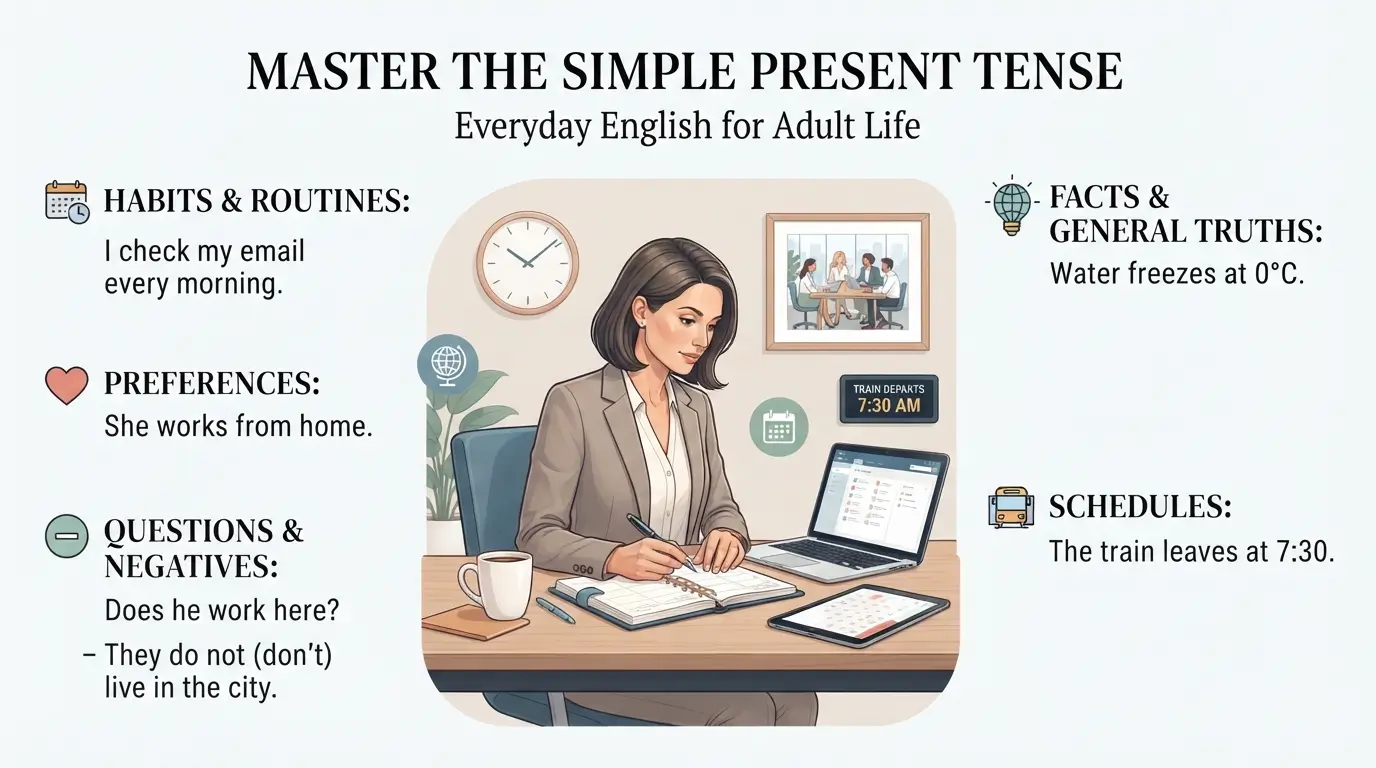
The simple present tense is probably the most frequently used tense in English — and also the one that produces the most consistent, avoidable mistakes for learners at almost every level.
It covers a wide range of everyday use: talking about routines, habits, facts, general situations, preferences, things that happen on a fixed schedule. You'd use it to describe your work, explain your daily routine, state an opinion, ask a question, give an instruction, or read out a departure board.
The basic structure isn't complicated. What tends to go wrong is the -s or -es ending with he, she, and it; the difference between don't and doesn't; and the particular way the verb be behaves differently from everything else. Getting clear on those three things handles most of the errors that tend to recur.
What Is the Simple Present Tense?
The simple present describes actions or situations that are regularly true, or generally true, or stable over time.
"I drink coffee every morning." "She works in a bank." "They visit their parents on Sundays." "Water boils at 100°C." All simple present. All describing something that's consistently the case rather than something happening right now in this specific moment.
It also covers more permanent situations: "I live in a small apartment." "She knows the answer." "My brother works from home." None of these are temporary — which is part of what separates the simple present from the present continuous, though that's a separate conversation.
Simple Present Tense Structure
The structure shifts depending on whether the sentence is positive, negative, or a question.
Fig. 1 — Simple present tense structure at a glance
Positive Sentences
With I, you, we, and they, use the base form of the verb.
"I work in an office." "You speak English well." "We study together." "They play football on Fridays."
With he, she, and it, the verb takes -s or -es.
"He works in an office." "She speaks English well." "My brother studies at night." "The machine works properly."
Negative Sentences
Negatives use don't or doesn't — and one of the most common errors is getting these mixed up.
Don't goes with I, you, we, they. Doesn't goes with he, she, it.
"I don't watch television every day." "We don't eat out often." "She doesn't drink coffee." "He doesn't live here."
One rule worth fixing firmly: after doesn't, the main verb goes back to its base form. ✓ "She doesn't work here." ✗ "She doesn't works here."
Questions
Questions start with do or does, followed by the subject, then the base verb.
"Do you work here?" "Do they speak English?" "Does she live nearby?" "Does your brother drive to work?"
Same rule applies: the main verb stays in its base form after does. ✓ "Does he play tennis?" ✗ "Does he plays tennis?"
When Do We Use the Simple Present Tense?
1. Daily Habits and Routines
This is the most common use — activities that happen on a regular basis.
"I check my email every morning." "She walks to work." "We have dinner at around eight." "He usually reads before going to bed."
Words like always, usually, often, sometimes, rarely, and never tend to travel with these sentences.
2. Facts and General Truths
The simple present handles things that are consistently true, including scientific or universally accepted facts.
"The Earth revolves around the Sun." "Water freezes at 0°C." "Plants need sunlight to grow."
3. Permanent or Long-Term Situations
Stable situations — ones unlikely to change soon — tend to use the simple present rather than the present continuous.
"I live in a small apartment." "She works for an international company." "He knows several languages."
4. Likes, Dislikes, and Opinions
Preferences and opinions typically take the simple present.
"I like classical music." "She doesn't enjoy crowded places." "We prefer tea to coffee." "He believes the plan will work."
5. Timetables and Scheduled Events
One use that surprises some learners: the simple present can describe future events when they're part of a fixed schedule.
"The train leaves at 7:30 tomorrow morning." "The meeting starts at 10 a.m." "The store opens at nine."
This works because a schedule has a fixed, impersonal quality — the departure time doesn't shift based on intention or circumstance.
6. Instructions and Directions
Step-by-step instructions and directions naturally fall into the simple present.
"First, you open the application. Then, you enter your password." "You turn left at the traffic lights."
Simple Present Tense Rules for He, She, and It
This is where most of the errors happen, so it's worth going through carefully.
Add -s to Most Verbs
| Base Verb | He/She/It Form | Example |
|---|---|---|
| work | works | She works from home. |
| read | reads | He reads the newspaper every morning. |
| play | plays | My sister plays tennis. |
| drink | drinks | He drinks tea at lunch. |
| live | lives | She lives near the office. |
Add -es to Certain Verbs
Verbs ending in -s, -sh, -ch, -x, and -o take -es.
| Base Verb | He/She/It Form | Example |
|---|---|---|
| wash | washes | She washes the dishes after dinner. |
| watch | watches | He watches football every weekend. |
| pass | passes | She passes the office every day. |
| fix | fixes | He fixes computers for a living. |
| go | goes | My father goes to work early. |
Verbs Ending in Consonant + Y
When a verb ends in a consonant followed by y, change y to i and add -es.
| Base Verb | He/She/It Form | Example |
|---|---|---|
| study | studies | She studies English every evening. |
| try | tries | He tries to arrive early. |
| carry | carries | She carries her laptop everywhere. |
| reply | replies | My manager replies to emails quickly. |
When the letter before y is a vowel, just add -s: play → plays, enjoy → enjoys, stay → stays.
Common Irregular Forms
Three verbs worth memorizing separately:
have → has: "She has two brothers." do → does: "He does his work carefully." be → am/is/are: "I am tired." "She is busy." "They are ready."
Time Expressions Used With the Simple Present
| Time Expression | Example |
|---|---|
| always | I always check my messages. |
| usually | She usually walks to work. |
| often | We often eat lunch together. |
| sometimes | He sometimes works late. |
| rarely | They rarely travel in winter. |
| never | I never skip breakfast. |
| every day | She studies every day. |
| once a week | We meet once a week. |
| on Mondays | I work from home on Mondays. |
Adverbs like always, usually, often, sometimes, rarely, and never go before the main verb: "I usually wake up early." "She often takes the bus." With the verb be, the adverb comes after: "She is always polite." "He is usually busy."
Longer time expressions can go at either end of the sentence: "I go to the gym every Saturday" and "Every Saturday, I go to the gym" are both fine.
The Verb "Be" in the Simple Present
Be works differently from other verbs. You don't use do or does to form questions and negatives with be — it forms them on its own.
| Subject | Be form | Example |
|---|---|---|
| I | am | I am ready. |
| he/she/it | is | She is a teacher. |
| you/we/they | are | They are at home. |
Negative: "I am not tired." "He is not available." "We are not late."
Questions: "Am I early?" "Is she your manager?" "Are they from Canada?"
Worth comparing: with a regular verb, you use do/does — "Do you work here?" "She doesn't work here." With be, you don't need those: "Are you a manager?" "She isn't a manager."
Common Mistakes With the Simple Present
Mistake 1 — Forgetting -s with he, she, or it.
✗ He work in a bank.
✓ He works in a bank.
Mistake 2 — Adding -s after does.
✗ Does she likes coffee?
✓ Does she like coffee?
After does, the verb goes back to its base form.
Mistake 3 — Using don't with he, she, or it.
✗ She don't understand.
✓ She doesn't understand.
Mistake 4 — Using doesn't with I, you, we, or they.
✗ They doesn't live here.
✓ They don't live here.
Mistake 5 — Mixing up be and do/does.
✗ I am not agree with you.
✓ I don't agree with you.
✗ He is work in an office.
✓ He works in an office.
Use am/is/are when be itself is the main verb. Use do/does with ordinary verbs.
Simple Present Tense Examples in Everyday English
At Work
"I start work at nine." "She answers customer emails." "We don't have meetings on Friday." "Does your manager work here?"
At Home
"I cook dinner most evenings." "My brother watches television after work." "We don't eat late." "Do you usually clean on weekends?"
Preferences
"I like black coffee." "She doesn't like crowded restaurants." "They prefer working in the morning." "Does he enjoy his new job?"
Routines
"I wake up at six." "He takes the bus to work." "We usually have lunch at one." "They go shopping every Saturday."
Practice Exercise
Complete each sentence with the correct form of the verb:
- She ________ English every evening. (study)
- They ________ to work by bus. (go)
- He ________ coffee. (not like)
- ________ you work on Saturdays? (do)
- ________ she live near your office? (do)
- My brother ________ football every weekend. (play)
Show Answers
1. studies · 2. go · 3. doesn't like · 4. Do · 5. Does · 6. plays
Quick Reference Guide
| Sentence Type | Structure | Example |
|---|---|---|
| Positive (I/you/we/they) | Subject + verb | They work here. |
| Positive (he/she/it) | Subject + verb-s/es | He drives to work. |
| Negative (I/you/we/they) | Subject + don't + verb | They don't smoke. |
| Negative (he/she/it) | Subject + doesn't + verb | She doesn't smoke. |
| Question (I/you/we/they) | Do + subject + verb? | Do they work here? |
| Question (he/she/it) | Does + subject + verb? | Does she work here? |
| Be (positive) | Subject + am/is/are | They are busy. |
| Be (negative) | Subject + am/is/are + not | She isn't ready. |
| Be (question) | Am/Is/Are + subject? | Are they coming? |
How to Practice the Simple Present Tense
The most efficient way to get the simple present feeling automatic is connecting practice to your own actual life rather than working through abstract exercises.
Write five sentences about a normal day: "I wake up at..." "I usually..." "I work/study..." "I have lunch at..." "I go to bed..." Then write five negatives and five questions using the same content. Something like: "I don't drink coffee at night." "My friend doesn't work on Fridays." "Do you exercise every morning?" "Does your sister live nearby?"
Short, repeated practice tied to real situations tends to build pattern recognition faster than memorizing rule lists alone.
Frequently Asked Questions
What is the simple present tense?
The simple present tense is used for habits, routines, facts, general situations, preferences, and regularly repeated actions.
What is the formula for the simple present tense?
For positive sentences: subject + base verb (with -s or -es for he/she/it). For negatives: subject + don't/doesn't + base verb. For questions: do/does + subject + base verb.
When do I use do and does?
Use do with I, you, we, and they. Use does with he, she, and it. "Do they work here?" "Does he work here?"
When do I add -s or -es to a verb?
Add -s or -es when the subject is he, she, or it in an affirmative sentence. "She works." "He watches." "It goes."
How do I make negative sentences in the simple present?
Use don't with I, you, we, they — and doesn't with he, she, it — followed by the base form of the verb. "They don't work here." "She doesn't work here."
Can the simple present talk about the future?
Yes. It can describe future events that are fixed or scheduled. "The train leaves at 8 p.m." "The meeting starts tomorrow at 10."
What is the difference between do and be?
Do/does is used with ordinary verbs when forming negatives and questions. Am/is/are are forms of the verb be and follow their own patterns. "Do you work here?" but "Are you a teacher?"
The Foundation Tense Worth Getting Right
The simple present is genuinely one of the foundations of English grammar — not in an abstract sense, but practically: it shows up in almost every conversation, email, presentation, and workplace exchange.
The structural rules are relatively few. Use the base verb with I, you, we, and they. Add -s or -es with he, she, and it. Use don't or doesn't for negatives, with the verb returning to its base form. Use do or does to open a question, again with the base verb following.
Once those patterns sit comfortably in memory — and more importantly, in speaking — the simple present tends to take care of itself across a wide range of everyday situations, from talking about a daily routine to reading out a meeting schedule to explaining what a colleague typically does.