The present continuous tense gets used constantly in everyday English, and yet it's one of the forms that learners tend to misapply most often — either using it where the simple present would fit better, or skipping it entirely in situations where it's genuinely the right choice.
At its core, it describes what's happening now, or what's happening in an extended temporary sense around the present, or something already arranged for the near future. Sitting at a desk writing an email: "I am writing an email." A company running a new initiative this quarter: "We are working on a new project." A meeting confirmed for Thursday: "I am meeting my manager tomorrow."
Once the structure and the main uses are clear, the tense tends to click into place fairly quickly.
What Is the Present Continuous Tense?
The present continuous describes an action or situation that's in progress at or around the present time.
It's built from a present form of the verb be — am, is, or are — followed by the -ing form of the main verb.
"I am reading a book." "She is talking to her manager." "We are preparing for the client visit." "They are working on the quarterly report."
One thing worth clarifying early: the action doesn't have to be happening at the exact second of speaking. "I am learning Spanish" could mean the person isn't studying at this precise moment but is currently involved in that process. That broader, temporary-present sense is just as valid as the immediate one.
Present Continuous Tense Formula
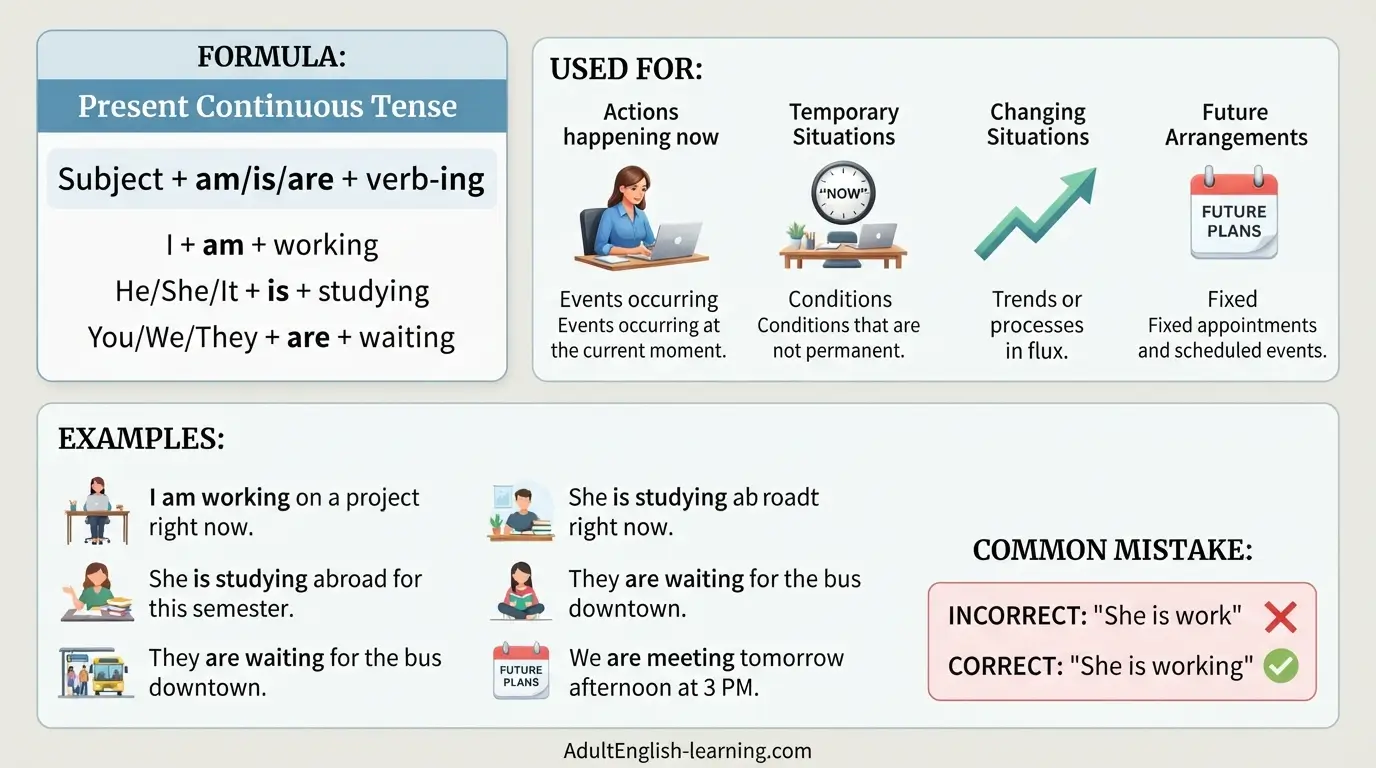
The basic structure: subject + am/is/are + verb-ing + rest of sentence.
| Subject | Be | Verb-ing | Example |
|---|---|---|---|
| I | am | working | I am working. |
| You | are | studying | You are studying. |
| He | is | driving | He is driving. |
| She | is | cooking | She is cooking. |
| It | is | raining | It is raining. |
| We | are | waiting | We are waiting. |
| They | are | discussing | They are discussing. |
The form of be changes with the subject; the main verb stays in its -ing form throughout.
Fig. 1 — Present continuous tense structure at a glance
Positive Sentences in the Present Continuous
Affirmative sentences follow subject + am/is/are + verb-ing.
"I am writing a report." "He is waiting for the bus." "She is preparing for an interview." "We are having lunch." "The company is hiring new employees."
These describe activities happening now or during the current period — both are fine uses of the same form.
Negative Sentences
To make a negative, add not after am, is, or are.
Structure: subject + am/is/are + not + verb-ing.
"I am not sleeping." "She is not working today." "We are not watching television." "They are not attending the meeting."
Contracted forms tend to be more natural in everyday English: isn't replaces is not, aren't replaces are not.
"She isn't feeling well." "He isn't coming today." "We aren't waiting for them." "They aren't using the office."
With I, the contraction is always I'm not — never ain't in a professional context: "I'm not working today." "I'm not watching television."
Questions in the Present Continuous
For yes/no questions, move am, is, or are to the front.
Structure: Am/Is/Are + subject + verb-ing?
"Am I speaking too quickly?" "Are you working today?" "Is she coming with us?" "Are they waiting outside?"
Wh-Questions
Add a question word first, then follow the same structure.
Structure: Wh-word + am/is/are + subject + verb-ing?
"What are you doing?" "Where is she going?" "Why are they laughing?" "What is he working on?" "Who are you talking to?"
These are among the most common conversational patterns in everyday English — worth learning as set phrases as much as grammatical structures.
When Do We Use the Present Continuous?
1. Actions Happening Right Now
The clearest use: something happening at the moment of speaking.
"I am writing an article right now." "She is talking to a customer." "It is raining outside."
Words like now, right now, at the moment, and currently tend to accompany this use.
2. Temporary Situations
The present continuous covers something happening during the current period but not as a permanent arrangement.
"I am staying with my brother this month." "She is working from home this week." "He is taking an evening course this year."
The contrast with the simple present is worth keeping in mind: "I work in Dhaka" describes a permanent or long-term situation; "I am working from home this week" describes something temporary.
3. Changing or Developing Situations
When something is gradually shifting, the present continuous tends to fit better than the simple present.
"The weather is getting warmer." "The company is growing." "More people are working remotely these days."
The idea here is process — an ongoing change rather than a settled fact.
4. Future Arrangements
The present continuous can describe a future event that's already been organized or confirmed.
"I am meeting my manager tomorrow." "We are having dinner with friends tonight." "She is traveling to Singapore next week." "They are starting the project on Monday."
A future time expression usually makes the meaning clear that this refers to an arrangement, not something happening right now.
5. Repeated Actions That Cause Annoyance
A less common but genuinely useful use: repeated behavior, especially when the speaker's frustration is part of the point.
"He is always interrupting me during calls." "You are constantly checking your phone in meetings." "She is always leaving her documents on my desk."
The word always makes the repetition explicit; the continuous form adds a layer of irritation that the simple present alone doesn't carry.
Present Continuous Time Expressions
| Time Expression | Example |
|---|---|
| now | I am working now. |
| right now | She is talking right now. |
| at the moment | We are having a meeting at the moment. |
| currently | He is currently looking for a new role. |
| today | I am working from home today. |
| this week | They are staying here this week. |
| this month | She is taking an English course this month. |
| these days | More people are working remotely these days. |
Rules for Adding -ing
Forming the -ing form is usually straightforward, but a few spelling patterns are worth knowing.
Most Verbs: Add -ing Directly
work → working, read → reading, play → playing, talk → talking.
"She is reading a report." "They are playing football."
Verbs Ending in Silent -e
Drop the e before adding -ing: write → writing, make → making, come → coming, take → taking.
"I am writing an email." "She is making dinner."
Short Verbs With a Doubled Final Consonant
Short verbs that end in a single consonant after a short vowel typically double that consonant: run → running, sit → sitting, swim → swimming.
"He is running in the park." "She is sitting near the window."
Verbs Ending in -ie
Change -ie to y before adding -ing: lie → lying, die → dying.
"The dog is lying under the table."
Spelling patterns can vary, and real reading and listening practice tends to reinforce these more reliably than rule lists alone.
Present Continuous vs. Simple Present
This distinction trips people up more than almost any other in English grammar, so it's worth being precise about it.
The simple present generally covers habits, routines, facts, and relatively permanent situations. The present continuous focuses on what's happening now, or temporarily, or currently developing.
| Simple Present | Present Continuous |
|---|---|
| I work in a bank. (permanent) | I am working from home today. (temporary) |
| She studies English every evening. (habit) | She is studying for an exam this week. (current activity) |
| They play football on Fridays. (routine) | They are playing football right now. (happening now) |
The difference is often habit versus current activity, or permanent situation versus temporary one. Getting that distinction clear tends to resolve most of the confusion between the two forms.
Common Mistakes With the Present Continuous
Mistake 1 — Forgetting the verb be.
✗ I working today.
✓ I am working today.
The present continuous always needs am, is, or are.
Mistake 2 — Forgetting -ing.
✗ She is work from home.
✓ She is working from home.
Mistake 3 — Using the wrong form of be.
✗ They is waiting outside.
✓ They are waiting outside.
✗ He are talking to his friend.
✓ He is talking to his friend.
Mistake 4 — Using the continuous for general facts.
✗ Water is boiling at 100°C. (general scientific fact)
✓ Water boils at 100°C.
Though "The water is boiling now" is perfectly correct when referring to what's happening in front of you.
Mistake 5 — Using the continuous with stative verbs.
Verbs describing states rather than actions — know, understand, believe, want, need, like, love, hate, own, belong — aren't usually used in the continuous form.
✓ I know the answer. ✗ I am knowing the answer.
English has exceptions, and some verbs shift meaning depending on how they're used, so learning the common patterns through real examples tends to work better than memorizing an absolute rule here.
Present Continuous Examples in Everyday English
At Work
"I am preparing a presentation." "My manager is talking to a client." "We are discussing the new project." "They are working on the monthly report."
At Home
"I am cooking dinner." "My brother is watching television." "We are cleaning the house." "The children are playing in the garden."
While Traveling
"We are waiting for the train." "She is looking for her passport." "They are checking the departure board." "I am talking to the receptionist."
For Future Arrangements
"I am meeting a friend tonight." "We are flying to Bangkok next week." "She is starting her new job on Monday." "They are visiting us this weekend."
Practice Exercise
Complete each sentence using the correct present continuous form:
- I ________ an email right now. (write)
- She ________ dinner at the moment. (cook)
- They ________ for the bus. (wait)
- We ________ a new project this month. (develop)
- He ________ today. (not / work)
- ________ you ________ for the exam? (study)
- The children ________ outside. (play)
- Why ________ she ________? (cry)
Show Answers
1. am writing · 2. is cooking · 3. are waiting · 4. are developing · 5. is not working · 6. Are / studying · 7. are playing · 8. is / crying
Quick Reference Guide
| Use | Example |
|---|---|
| Happening now | I am speaking to you. |
| Temporary situation | She is working from home this week. |
| Developing situation | The company is growing fast. |
| Future arrangement | We are meeting tomorrow morning. |
| Repeated irritating action | He is always complaining. |
How to Practice the Present Continuous
One of the more efficient practice methods: describe what's actually happening around you right now.
Look around your home or workplace and make five sentences from what you can see — "Someone is talking nearby," "The computer is running," "My colleague is working at the other desk," "The phone is ringing." That ties the grammar to a genuinely real situation rather than an abstract exercise.
It's also worth practicing the temporary-present use, not just the immediate one. Describe your current week: "I am learning English this month," "I am working on a new project," "I am preparing for an interview." That builds a feel for how far the tense actually reaches beyond the current moment.
Frequently Asked Questions
What is the present continuous tense?
The present continuous tense describes actions happening now, temporary situations, developing situations, and planned future arrangements.
What is the formula for the present continuous tense?
Subject + am/is/are + verb-ing. For example: "She is reading a book."
How do I make negative sentences in the present continuous?
Add not after am, is, or are: "She is not working today" or "She isn't working today."
How do I form questions in the present continuous?
Move am, is, or are to the front: "Is she working?" For wh-questions: "What is she working on?"
What are the helping verbs in the present continuous?
Am, is, and are. Use am with I; is with he, she, and it; are with you, we, and they.
Can the present continuous describe future plans?
Yes. It can describe an arrangement already made: "We are meeting the client tomorrow."
What is the difference between simple present and present continuous?
The simple present covers habits, routines, and general facts. The present continuous covers what's happening now or temporarily. "I work in an office" vs "I am working from home today."
Which verbs are usually not used in the present continuous?
Stative verbs — know, understand, believe, want, need, like, own, belong — are generally not used in the continuous form when describing a state.
How do I add -ing to a verb?
Most verbs: add -ing directly. Verbs ending in silent e: drop the e first (write → writing). Short verbs ending in a consonant after a short vowel: double the consonant (run → running). Verbs ending in -ie: change to y (lie → lying).
The Pattern Worth Making Automatic
The present continuous becomes considerably easier once the central pattern — am/is/are + verb-ing — sits automatically in memory rather than having to be assembled consciously each time.
From there, the main skill is recognizing the situation: something happening now, something temporary around the present, a process currently developing, or a confirmed future arrangement. Each calls for the same form; what shifts is the context and the time expression attached.
Pay particular attention to the form of be, the -ing spelling rules, and the contrast with the simple present. Short, repeated practice tied to real situations — your own week, your workplace, your surroundings — tends to build that pattern recognition faster than abstract exercises ever do.