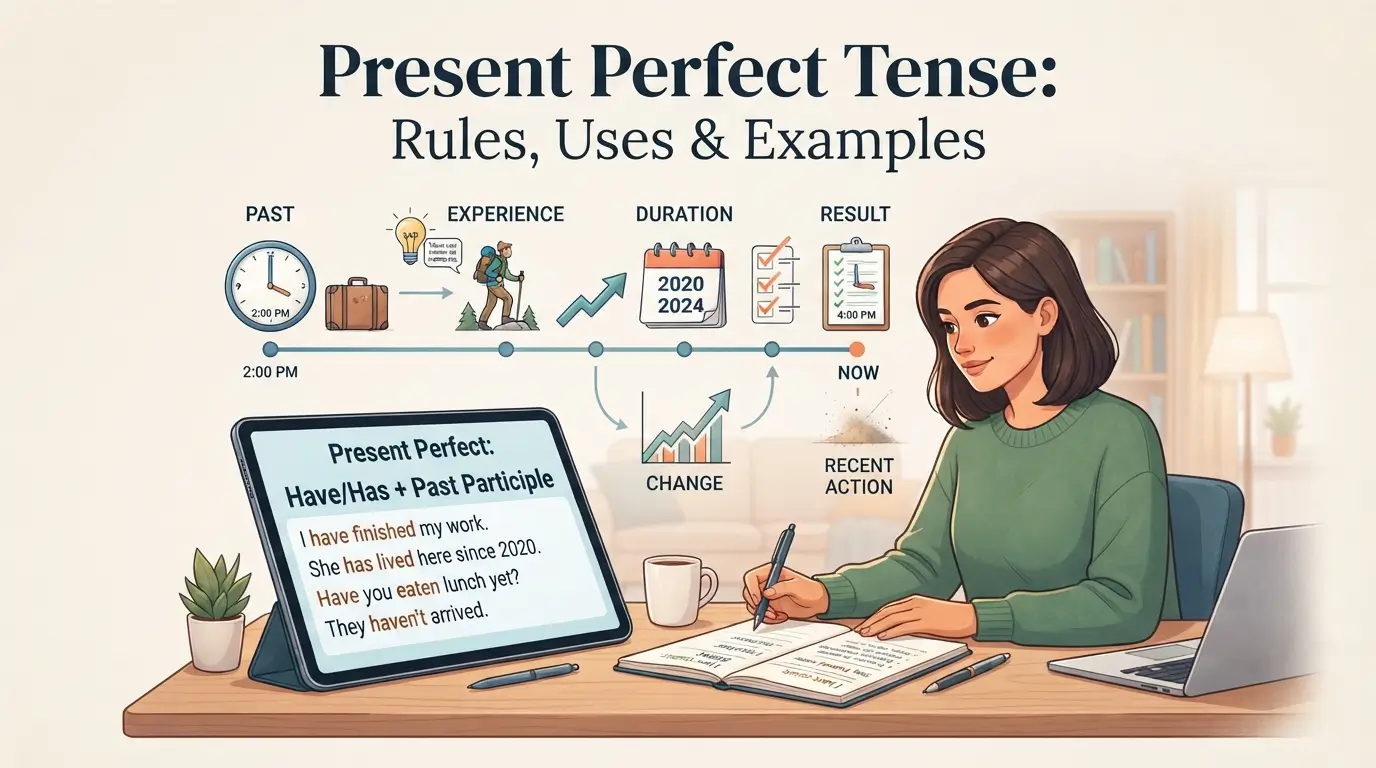
The present perfect is probably the tense that gives English learners the most sustained trouble — not because the structure is complicated, but because it doesn't behave the way past tenses behave in most other languages. Using it well requires understanding not just what happened, but why it's being connected to right now.
"I have finished my report." "She has visited Singapore several times." "We have lived here for six years." In each of these, something happened in the past — but the speaker's attention is on what that past event means for the present, not on when exactly it occurred. That connection to now is what the present perfect is really doing.
Once that central idea is clear, the rest tends to follow.
What Is the Present Perfect Tense?
The present perfect describes an action or situation that happened before now and has some connection with the present. The exact timing may be unknown, unspecified, or beside the point — the speaker is usually more interested in the experience, the result, the duration, or the change.
The contrast with the past simple is worth establishing early, because this is where most confusion starts.
"I have lost my wallet" suggests the wallet is still missing right now — the loss has a present consequence. "I lost my wallet yesterday" gives a definite time and treats it as a closed, completed past event. Same situation, different angle.
The present perfect doesn't simply mean something happened in the past. It means there's a reason to connect that past event to this moment.
Present Perfect Tense Formula
The structure: subject + have/has + past participle.
Have goes with I, you, we, and they. Has goes with he, she, and it.
| Subject | Helping Verb | Example |
|---|---|---|
| I | have | I have finished. |
| You | have | You have finished. |
| We / They | have | We have finished. |
| He / She / It | has | She has finished. |
The main verb appears in its past participle form. For regular verbs, that typically ends in -ed: work → worked, finish → finished, clean → cleaned. Irregular verbs have their own forms worth memorizing: go → gone, write → written, see → seen, eat → eaten, take → taken.
Fig. 1 — Present perfect tense structure at a glance
Affirmative Sentences
Positive sentences follow subject + have/has + past participle.
"I have completed the application." "She has started a new job." "They have seen this film before." "He has written three emails today."
Each of these connects a past action to what's true or relevant right now.
Negative Sentences
Add not after have or has: subject + have/has + not + past participle.
"I have not finished the report yet." "She has not replied to my message." "We have not decided where to go." "They have not arrived yet."
Contracted forms tend to be more natural in everyday speech: have not → haven't, has not → hasn't.
"I haven't finished the work yet." "She hasn't called me today."
Questions in the Present Perfect
For yes/no questions, have or has moves before the subject.
"Have you finished the report?" "Has she arrived yet?" "Have they seen this movie?" "Have we met before?"
Wh-Questions
Add a question word first, then the usual structure.
"Where have you been?" "What has she done?" "How long have they worked here?" "Why has he left early?" "How many times have you visited London?"
These wh-questions are common in professional and everyday contexts, particularly when asking about duration or frequency.
When Do We Use the Present Perfect?
1. Life Experiences
The present perfect is well-suited to talking about something a person has or hasn't experienced, when the exact time doesn't matter — or simply isn't the point.
"I have visited Thailand twice." "She has never ridden a horse." "Have you ever tried Ethiopian food?" "He has never worked abroad."
The experience itself is what's being discussed. Ever, never, before, and expressions like several times or many times tend to show up in this use.
2. Situations Continuing Until Now
When something began in the past and is still true or ongoing, the present perfect handles it.
For describes a period of time — "for three years," "for two weeks," "for a long time." Since identifies the starting point — "since 2020," "since Monday," "since childhood."
"I have worked here for five years." "She has lived in this city since 2019." "We have known each other for a long time." "He has studied English since he was a teenager."
The key: the situation is still continuing now, not closed in the past.
3. Recent Actions With a Present Result
When something has just happened and its consequence is still relevant, the present perfect fits.
"I have lost my phone." "She has just finished her presentation." "They have already left the office." "He has broken his glasses." "We haven't received the email yet."
Just, already, and yet tend to cluster here. "She has just arrived" means the arrival happened very recently and is relevant to what's happening right now.
4. Changes Over Time
When comparing the present situation to an earlier one, the present perfect tends to work well.
"My English has improved considerably." "The neighborhood has changed a lot." "The company has grown since I joined." "His pronunciation has become considerably clearer."
This use often appears in performance reviews, progress reports, and reflective conversations about development.
5. Repeated Actions Up to the Present
When an action has happened several times before now — and may happen again — the present perfect captures that pattern.
"I have watched that series three times." "She has called me several times today." "We have visited that restaurant many times." "He has applied for several positions this month."
The focus is on how often, up to this point.
Present Perfect Signal Words
| Word | Typical Meaning | Example |
|---|---|---|
| already | something happened before expected | She has already left. |
| yet | something expected hasn't happened | He hasn't arrived yet. |
| just | happened very recently | I have just finished. |
| ever | at any point in experience | Have you ever been there? |
| never | not at any point | I've never tried it. |
| since | starting point of a continuing situation | We have lived here since 2021. |
| for | duration of a continuing situation | She has worked here for five years. |
| recently | not long ago | They have recently moved offices. |
Worth treating these as useful clues rather than guaranteed indicators — context should always take priority over signal words alone.
Present Perfect vs. Past Simple
This is where most errors actually happen, and it's worth spending some time here.
The past simple describes a completed past event, often with a definite or finished time attached. The present perfect connects a past event to now, typically without specifying when it occurred.
| Present Perfect | Past Simple |
|---|---|
| I have visited Rome. (experience, no time given) | I visited Rome in 2022. (specific past time) |
| She has finished the report. (result matters now) | She finished the report yesterday. (closed past event) |
| We have lived here for six years. (still living here) | We lived there from 2015 to 2019. (no longer the case) |
| Have you ever eaten sushi? (life experience) | Did you eat sushi last night? (specific occasion) |
One practical rule: if the sentence includes a finished past time — yesterday, last week, last year, two days ago, in 2018 — the past simple is almost always the right choice.
✗ I have visited Paris last year.
✓ I visited Paris last year.
Common Mistakes With the Present Perfect
Mistake 1 — Forgetting have or has.
✗ She finished her work. (when present perfect is intended)
✓ She has finished her work.
Mistake 2 — Using the wrong verb form.
✗ I have went to London.
✓ I have gone to London.
After have or has, the past participle is needed — not the simple past form.
Mistake 3 — Using a finished past time.
✗ We have met in 2020.
✓ We met in 2020.
A specific finished year calls for the past simple.
Mistake 4 — Confusing for and since.
For goes with a duration: "I have worked here for five years." Since goes with a starting point: "I have worked here since 2021." Mixing the two is one of the most consistent errors in this tense.
Mistake 5 — Using the present perfect for every past event.
✗ I have watched a movie last night.
✓ I watched a movie last night.
Last night is a finished past time. Past simple wins.
Present Perfect in Everyday English
At Work
"I have completed the report." "We have received the client's message." "She has already sent the documents." "Have you finished the presentation?"
Daily Conversation
"Have you eaten yet?" "I've already had lunch." "I haven't seen him today." "Have you ever been to this restaurant?"
Talking About Travel
"I have visited Malaysia several times." "She has never traveled alone." "Have you ever been to Australia?"
Practice Exercise
Complete each sentence using the correct present perfect form:
- She ________ her work already. (finish)
- I ________ Canada. (never / visit)
- They ________ here since 2020. (live)
- He ________ me yet. (not / call)
- We ________ this movie three times. (see)
- My English ________ a lot this year. (improve)
- ________ you ever ________ Korean food? (try)
- She just ________ the email. (send)
Show Answers
1. has finished · 2. have never visited · 3. have lived · 4. has not called · 5. have seen · 6. has improved · 7. Have / tried · 8. has sent
Quick Reference
| Sentence Type | Structure | Example |
|---|---|---|
| Affirmative | Subject + have/has + past participle | They have completed the project. |
| Negative | Subject + haven't/hasn't + past participle | They haven't completed the project. |
| Question | Have/Has + subject + past participle? | Have they completed the project? |
How to Practice the Present Perfect
Connecting the tense to real personal experience tends to make it click faster than working through abstract exercises.
Ask yourself: What have I done today? What places have I visited? What have I learned recently? How long have I lived in my current city? What have I never tried?
Then answer in complete sentences. "I have learned several new English expressions this week." "I have lived in this city for many years." "I have never traveled alone." Building that habit of thinking in the tense — rather than translating from another language's past form — tends to make the distinction between present perfect and past simple feel considerably more natural over time.
Frequently Asked Questions
What is the present perfect tense?
The present perfect describes past actions, experiences, or situations that have a connection with the present.
What is the formula for the present perfect?
Subject + have/has + past participle. For example: "She has finished the report."
When do we use the present perfect?
For life experiences, situations continuing until now, recent events with present results, changes over time, and repeated actions up to the present.
What is the difference between present perfect and past simple?
The present perfect connects a past event to the present; it typically doesn't specify a finished time. The past simple describes completed events, often with a definite past time.
What is the difference between for and since?
For describes a duration: "for five years." Since identifies a starting point: "since 2021."
Can I use already, yet, and just with the present perfect?
Yes. Already means something happened before expected; yet means something expected hasn't happened; just means something happened very recently.
What is a past participle?
The third form of a verb, used after have/has. Regular verbs often end in -ed; irregular verbs have their own forms: go → gone, write → written, see → seen.
Can I use a specific past time with the present perfect?
Generally not. When a sentence includes a finished time — yesterday, last week, in 2018 — the past simple is normally the right choice.
Past Meets Present: Getting This Tense Right
The present perfect becomes considerably more manageable once the central idea is clear: it connects something that happened before now to what's true or relevant in this moment.
Start with have/has + past participle, then practice each of the five main uses against real situations from your own life. Pay particular attention to the for/since distinction, the contrast with the past simple, and the signal words that tend to cluster around each use.
With enough regular practice — especially the kind tied to your own experiences rather than abstract exercises — these patterns tend to become genuinely automatic rather than something that needs to be consciously assembled each time.