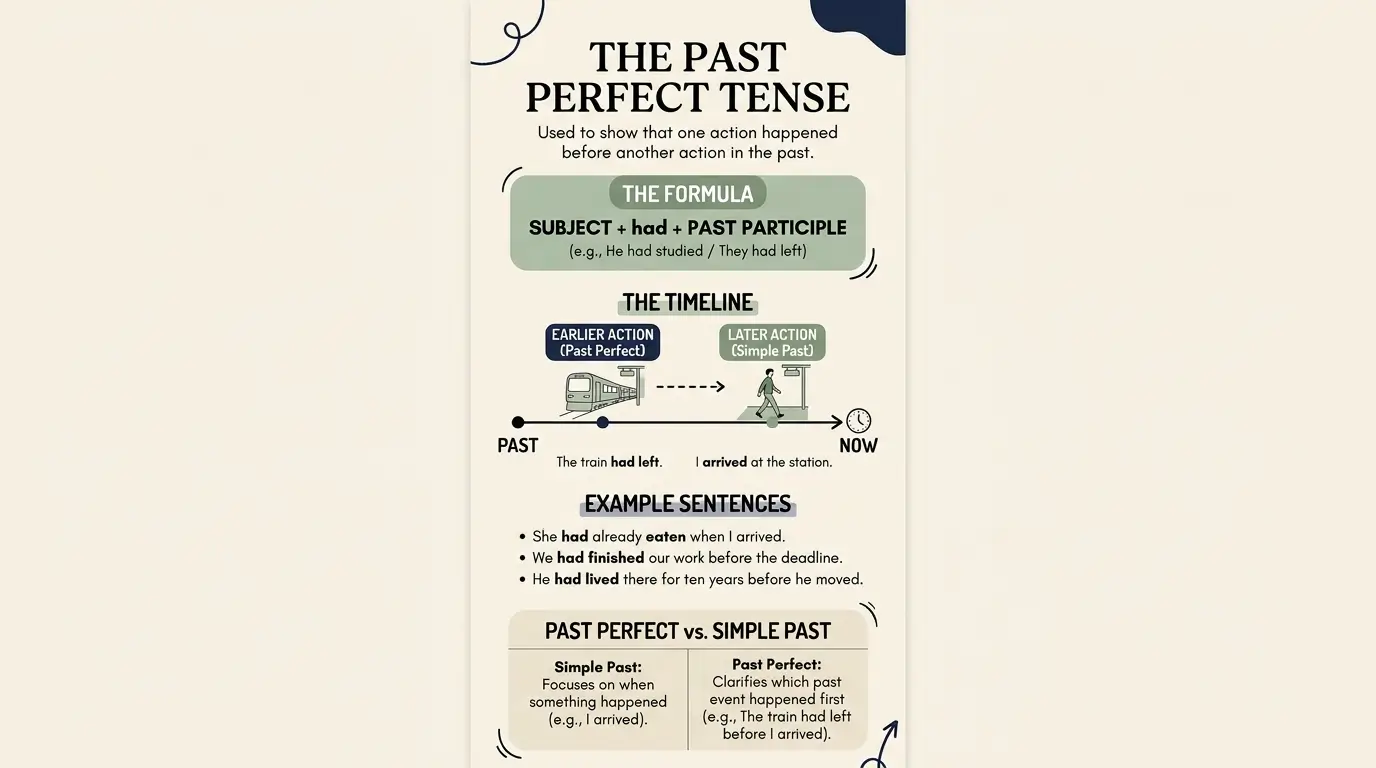
The past perfect solves a specific problem: how do you make clear that one past event happened before another past event? The simple past alone can't always do that cleanly.
"When I reached the station, the train had left." Both events happened in the past. But they didn't happen together. The train left first — and the past perfect is what signals that. Without it, "when I reached the station, the train left" could suggest the two things happened at the same time.
That's really the core of what this tense does: it marks the earlier event in a two-event past sequence.
What Is the Past Perfect Tense?
The past perfect describes an action or situation that was already complete before another past event or a specific point in the past. It's sometimes called the "past before the past" — which is a bit awkward but genuinely accurate.
"She had finished her assignment before the meeting started." "By the time we reached the cinema, the film had begun." In each case, the past perfect event is the earlier one; the simple past event comes after.
Past Perfect Tense Formula
The structure: subject + had + past participle.
Had stays the same for every subject — I, you, he, she, it, we, they. No variation needed.
| Subject | Example |
|---|---|
| I | I had finished my work. |
| You | You had seen the notice. |
| He / She | She had called her manager. |
| We | We had booked the tickets. |
| They | They had left the office. |
The past participle is the third verb form. Regular verbs end in -ed; irregular verbs have their own forms.
| Base Verb | Simple Past | Past Participle |
|---|---|---|
| work | worked | worked |
| go | went | gone |
| see | saw | seen |
| write | wrote | written |
| eat | ate | eaten |
| do | did | done |
Worth fixing early: the past perfect uses the past participle, not the simple past. "Had gone," not "had went."
Fig. 1 — Past perfect tense structure at a glance
Forming Past Perfect Sentences
Positive
"I had saved the document before the computer shut down." "We had completed the project by Friday." "The shop had closed before I arrived."
Negative
Add not after had: "I had not seen that email before the meeting." "They had not booked a hotel before the prices increased."
In everyday English, hadn't is more natural: "She hadn't heard the news." "We hadn't met before that day."
Questions
Move had before the subject: "Had you finished the report before the deadline?" "Had they left when you arrived?"
For wh-questions, put the question word first: "Where had he gone?" "Why had they cancelled the meeting?"
Short answers: "Had she called you?" → "Yes, she had." / "No, she hadn't."
When Do We Use the Past Perfect?
1. To Show Which Past Action Happened First
The clearest, most common use. The past perfect marks the earlier event; the simple past marks the later one.
"The bus had left before we reached the stop." "I had locked the door before I went to bed." "She had prepared the presentation when her manager asked to see it."
2. To Explain a Past Situation or Result
When an earlier event explains why a later situation was the way it was.
"I was tired because I had slept badly the night before." "He knew the answer because he had studied the topic." "The ground was wet because it had rained overnight."
The past perfect connects the cause; the simple past carries the result.
3. Past Experiences Before a Reference Point
"Before she started university, she had never lived away from home." "It was the most challenging job he had ever done." "I had never tried Indian food before I visited Delhi."
The reference point here is in the past, not the present — which is what separates this use from the present perfect.
4. With "By the Time," "Before," and "Already"
"By the time we arrived, the guests had already eaten." "She had completed the course before she applied for the job." "The meeting had already started when I entered the room."
Already tends to sit between had and the past participle: had already finished.
5. In Third Conditional Sentences
The past perfect appears in the if-clause of third conditionals — sentences describing imagined past situations that didn't happen.
"If I had left earlier, I would have caught the train." "If she had studied more, she might have passed the exam." "We would have arrived on time if we had taken a taxi."
These are useful for expressing regret or discussing what might have gone differently.
6. In Reported Speech
When reporting what someone said about an earlier event, the past perfect helps show that event came before the reporting.
Direct: "I lost my keys." → Reported: "He said that he had lost his keys."
"She told me that she had sent the application the previous day."
Past Perfect vs. Simple Past
| Simple Past | Past Perfect |
|---|---|
| Completed past action | Action completed before another past event |
| I arrived at the office. | I had arrived before the meeting began. |
| She finished the report. | She had finished it before her manager called. |
| They left at six. | They had left before we got there. |
Compare: "When I arrived, Sam left" can imply the two things happened at the same time. "When I arrived, Sam had left" makes clear he was already gone. That gap — simultaneous versus sequential — is where the past perfect earns its place.
Avoid using it for a single past event with no earlier reference: "Yesterday, I had watched a film" sounds strained. "Yesterday, I watched a film" is what you'd actually say.
Common Adverbs With the Past Perfect
| Word | Example |
|---|---|
| already | The class had already started when I arrived. |
| just | The train had just departed when we reached the platform. |
| never | He had never flown before that trip. |
| ever | It was the best meal I had ever eaten. |
| yet | They hadn't finished the task yet. |
| still | At nine o'clock, I still hadn't received a reply. |
Already, just, never, and ever sit between had and the past participle. Yet tends to end a negative sentence. Still goes before hadn't to emphasize something remains unfinished.
Common Mistakes
Mistake 1 — Using the simple past instead of the past participle.
✗ She had went home.
✓ She had gone home.
Mistake 2 — Using have/has instead of had.
✗ They have finished before the manager arrived.
✓ They had finished before the manager arrived.
Mistake 3 — Using it when there's no earlier past event to reference.
✗ I had bought a new phone yesterday.
✓ I bought a new phone yesterday.
Mistake 4 — Wrong form in a question.
✗ Had she went to the office?
✓ Had she gone to the office?
Mistake 5 — Overusing it throughout a story.
Once the earlier event is established, the story can return to the simple past. The past perfect sets up the timeline; it doesn't need to carry every sentence that follows.
Practice Exercise
Complete each sentence with the correct past perfect form:
- When I arrived at the restaurant, my friends ________ already ________. (leave)
- She was nervous because she ________ never ________ in public before. (speak)
- ________ you ________ the email before the meeting started? (read)
- They ________ not ________ the tickets before the price increased. (buy)
- If he ________ harder, he might have passed the exam. (study)
- By the time we reached the station, the train ________. (go)
Show Answers
1. had already left · 2. had never spoken · 3. Had / read · 4. had not bought · 5. had studied · 6. had gone
Quick Summary
| Sentence Type | Structure | Example |
|---|---|---|
| Positive | Subject + had + past participle | They had finished the work. |
| Negative | Subject + hadn't + past participle | They hadn't finished the work. |
| Question | Had + subject + past participle? | Had they finished the work? |
Frequently Asked Questions
What is the past perfect tense?
The past perfect describes an action completed before another past event or a specific time in the past. "The film had started before we entered the cinema."
What is the formula for the past perfect?
Subject + had + past participle. Had is used with all subjects.
What is the difference between the past perfect and simple past?
The simple past describes a completed past event. The past perfect shows that something happened earlier than another past event or reference point.
How do I make a negative past perfect sentence?
Put not after had: "She had not finished the report." The contraction hadn't is common in everyday English.
Which words are often used with the past perfect?
Already, just, never, ever, yet, still, before, and by the time.
Is the past perfect always needed for two past actions?
No. When before or after makes the sequence clear, the simple past often works on its own. The past perfect is useful when the timeline genuinely needs clarifying.
Can I say "had had"?
Yes. The first had is the auxiliary verb; the second is the past participle of have. "I had had lunch before the meeting began" is perfectly correct.
Can the past perfect describe an unreal past situation?
Yes. It's standard in third conditional sentences: "If we had left earlier, we would have arrived on time."
One Event Before Another
The past perfect is a focused tool. It does one thing well: it signals that an event had already happened before the moment in the past being discussed.
The structure is straightforward — had + past participle, the same for every subject. The real skill is knowing when to reach for it, which tends to come from asking a simple question: am I describing two past events, and does it matter which came first?
Practice by describing a day when something went wrong — what had already happened before the problem occurred. That kind of real-context use tends to make the tense click faster than isolated exercises ever do.